



x402 is an open standard that lets any HTTP service charge for a request and get paid in stablecoins inside the same request flow, with no account, API key or checkout page. The plumbing is real and now has broad institutional backing, but the best independent data so far says genuine AI-agent spending over x402 is still tiny. As of 22 October 2026, TRM Labs estimates that agent-driven payments were between 0.6% and 7.5% of screened x402 commerce, on a base of roughly $25.6 million.
What x402 is
Coinbase introduced x402 on 6 May 2025. The name comes from HTTP status code 402, "Payment Required", which has been reserved in the HTTP standard for decades without a common way to use it. x402 fills that gap with a small set of message formats.
The specification defines three roles:
- Resource server: the API, website or service that wants to be paid.
- Client: any application or agent requesting the resource.
- Facilitator: a service that verifies payment payloads and settles them on chain, so the server does not need to run blockchain infrastructure. Servers can also host these endpoints themselves.
In the current (v2) HTTP transport, the cycle looks like this:
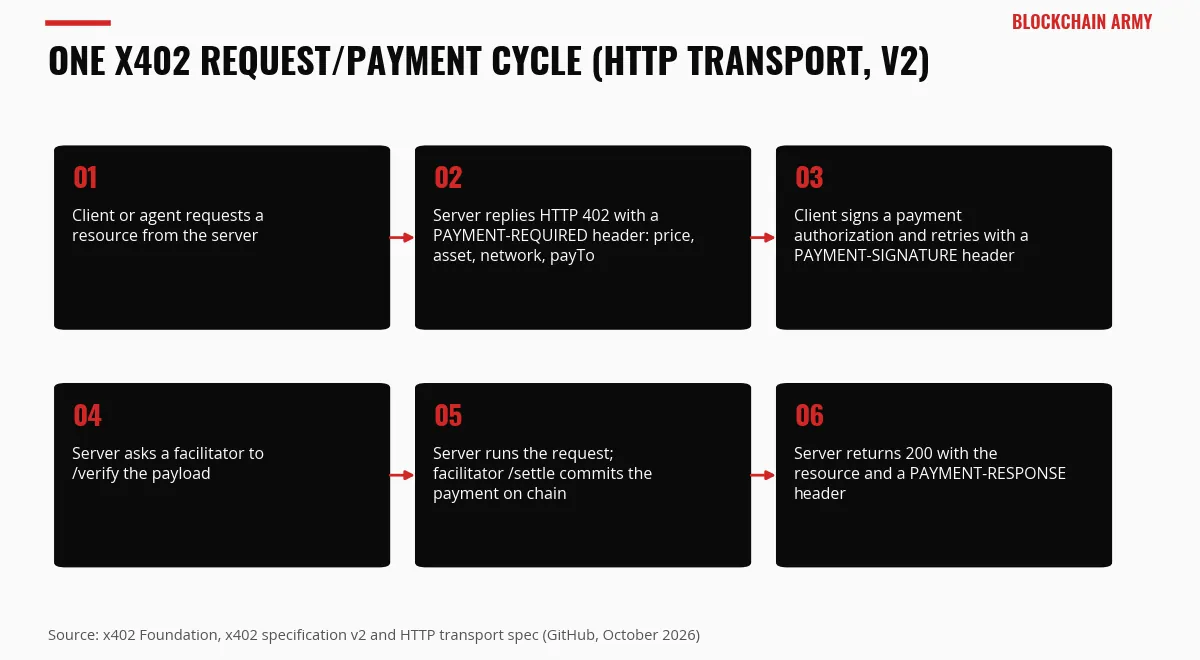
- The client requests a resource.
- The server answers
402 Payment Requiredwith aPAYMENT-REQUIREDheader that lists what it accepts: scheme, network, amount, asset and the address to pay. - The client signs a payment authorization and retries with a
PAYMENT-SIGNATUREheader. - The server calls the facilitator's
/verifyendpoint, runs the request, then calls/settle. - The server returns the resource with a
PAYMENT-RESPONSEheader containing the settlement result.
v1 used X-PAYMENT and X-PAYMENT-RESPONSE headers, and the spec asks servers that still support v1 clients to handle both spellings. Payment "schemes" define how money moves: exact for a fixed price, and upto for metered charges where the client authorizes a maximum and the server settles the actual amount. Other flows, such as upfront and escrow, settle before the resource runs.
Governance has also moved. The Linux Foundation announced the operational launch of the x402 Foundation on 14 July 2026 with 40 member organizations, including AWS, Circle, Cloudflare, Coinbase, Google, Mastercard, Stripe and Visa, after Coinbase contributed the protocol.
How x402 relates to MPP and AP2
Three names come up in every agent-payments conversation. They are not direct competitors so much as different layers.
| Protocol | Led by | Launched | What it does |
|---|---|---|---|
| x402 | Coinbase, now the x402 Foundation (Linux Foundation) | May 2025; foundation operational July 2026 | HTTP-native payment requests, mostly stablecoins on chains such as Base and Solana |
| Machine Payments Protocol (MPP) | Stripe and Tempo | 18 March 2026 | Open standard for agents to pay services; accepts stablecoins on Tempo and, through Stripe, cards and other methods, settling into the business's Stripe balance |
| Agent Payments Protocol (AP2) | Google with 60+ organizations | 16 September 2025 | Authorization layer: signed "mandates" that prove what a user asked an agent to buy; payment-agnostic, with an A2A x402 extension for stablecoins |
Stripe's announcement states that it supports payments over both MPP and x402. For builders, the practical takeaway is that the request-pay-retry pattern is converging, while the rails (stablecoin, card, bank) and the trust layer (who authorized the agent) are still being decided.
What the adoption numbers actually say
Headline x402 transaction counts are large. They are also the least useful number to quote, because the protocol cannot tell a person, a script and an agent apart.
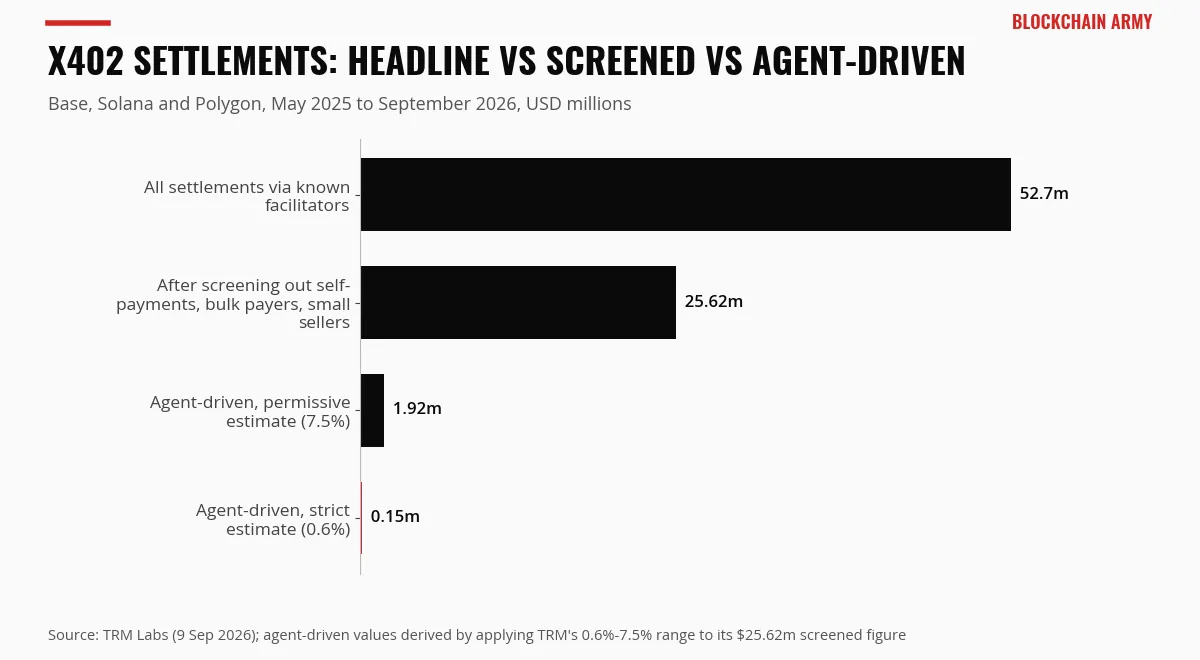
TRM Labs (9 September 2026) examined about $52.7 million across 198.9 million settlements by known facilitators on Base, Solana and Polygon since May 2025. Around 99.6% of value settled in USDC. TRM then removed addresses paying themselves, bulk flows from one or two payers, and sellers with fewer than ten distinct buyers. Roughly half the value disappeared, leaving about $25.6 million of likely commerce. Of that, it estimated agent-driven activity at 0.6% to 7.5%, depending on how strictly an "agent" is defined.
TRM also notes that late-2025 activity on Base was largely speculative, with much of it consistent with meme-token minting, and that agent-driven volume stayed around $5,000 to $11,000 per month even as agent counts peaked in mid-2026.
Chainalysis (14 October 2026) reported more than 138 million cumulative x402 transactions on Base by the end of its study period, with over 87% of payments between a hundredth of a cent and ten cents. It also found that newer wallets are funded and start spending much faster than early ones, which suggests more automated use. Chainalysis describes agentic commerce as still in an experimentation phase, and its count covers Base only.
These two reports measure different things. Chainalysis describes the shape of activity; TRM tries to isolate the share that looks like autonomous agents buying from multiple sellers. Neither supports the idea that agents are already a significant payment channel. Both support the idea that very small, machine-initiated payments work technically.
What teams should build for
If you run an API, data feed, model endpoint or content service, x402-style payments are worth preparing for without betting the business on them.
Metered APIs first. The clearest use case is pay-per-call access to data, inference or tools, where creating an account and API key is the main friction. Start with a narrow, high-value endpoint and an exact price; use upto only when you can meter reliably.
Agent wallets with hard limits. If you build agents that spend, give each one its own wallet with a small balance, per-request and per-day caps, and an allowlist of payees. TRM's report points out that no human approves an x402 payment before settlement, and that payment sizes sit below most value thresholds that compliance systems were built for.
Security on both sides. Servers should validate amount, asset, network and recipient on every payment, protect against replayed authorizations, and treat the facilitator as a dependency with its own failure modes. Clients should never let a model choose the payee or the amount without policy checks, since prompt injection can turn an agent into a payment instruction. For a related view on how AI companies are approaching financial tooling, see our piece on Claude's financial infrastructure.
Measure honestly. If you report x402 revenue or usage to investors or users, separate self-payments, test traffic and single-payer bulk flows from real buyers, as TRM did. Inflated agent metrics will be checked on chain.
Keep normal payments too. For most businesses, stablecoin checkout for humans is still the larger opportunity; our guide on how businesses accept crypto payments covers the basics.
Our AI blueprint work with teams usually starts with exactly these questions: which actions an agent may take on its own, what it can spend, and how every payment is logged and reviewed. In past client work across tokenomics, smart contracts and community, we have found that the controls around a system matter as much as the feature itself.
The bottom line
As of 22 October 2026, x402 is a working, openly governed standard with support from payment networks, cloud providers and Stripe, and agent payment protocols are converging on the same request-pay-retry pattern. The demand side is not there yet: independent analysis puts genuine agent spending in the thousands of dollars per month. Build the integration where it removes friction today, put strict limits on anything an agent can spend, and judge adoption by screened data, not headline transaction counts.
Sources
- x402 Foundation — x402 protocol specification v2 (GitHub)
- x402 Foundation — HTTP transport specification v2 (GitHub)
- Coinbase — Introducing x402: a new standard for internet-native payments (6 May 2025)
- Coinbase Developer Platform — x402 documentation
- Linux Foundation — Operational launch of the x402 Foundation (14 July 2026)
- Stripe — Introducing the Machine Payments Protocol (18 March 2026)
- Google Cloud — Announcing the Agent Payments Protocol (AP2) (16 September 2025)
- Coinbase — Google Agentic Payments Protocol + x402
- TRM Labs — Who's actually paying? Measuring AI agent payments onchain (9 September 2026)
- Chainalysis — North America crypto adoption 2026 (14 October 2026)
How we research, write and fact-check: Editorial & AI policy.
Disclaimer: this article is for informational and educational purposes only and does not constitute financial, investment, legal or tax advice. Crypto-assets are volatile and high-risk: always do your own research (DYOR) and consult a qualified professional before making any decision. Not financial advice.