



The 3 November 2026 midterms changed the political arithmetic for US crypto policy. The Associated Press called the House for Democrats in the early hours of 4 November, and Democrats also won a Senate majority, ending unified Republican control from January 2027. For crypto, the result shortens the remaining window for the CLARITY Act to the lame-duck session, and makes Senator Elizabeth Warren the expected, though not yet confirmed, chair of the Senate Banking Committee.
What the election results show so far
As of 10 November, final seat totals were still being counted in some races, and outlets reported different minimum tallies. The calls that matter for crypto policy are not in doubt:
- House. States Newsroom reported that the AP called the House for Democrats early on 4 November after the party passed the 218-seat threshold. The size of the majority was not final.
- Senate. The Hill reported on the night of 3 November that Democrats had won the Senate majority. Flipped seats included North Carolina (Roy Cooper), South Carolina (Annie Andrews) and Texas (James Talarico). Al Jazeera, citing AP projections, also listed Ohio, where Sherrod Brown won back a seat, along with Maine, Iowa and Kansas.
- Leadership. The Hill reported that Chuck Schumer is expected to be elected majority leader at Democratic leadership elections in early December, with John Thune expected to become minority leader.
Committee chairs are set when the new Congress organises in January. Fortune reported on 9 November that Warren is expected to chair Senate Banking and Sherrod Brown is likely to chair Senate Agriculture, which oversees the CFTC. Fortune described these gavels as "widely expected but not confirmed."
One more change was already known before election day. Senator Cynthia Lummis, the lead Republican author of the Senate's market-structure text, announced in December 2025 that she would not seek re-election. Her term ends in January 2027.
The CLARITY Act: a lame-duck question
The Digital Asset Market Clarity Act (H.R. 3633) passed the House 294–134 in July 2025. It cleared Senate Banking 15–9 in May 2026, then failed a cloture vote on the Senate floor 49–50 on 15 September 2026. Senator Thom Tillis entered a motion to reconsider that vote, which remains the latest action on the bill on Congress.gov. We covered that vote in detail in why the CLARITY Act stalled in the Senate.
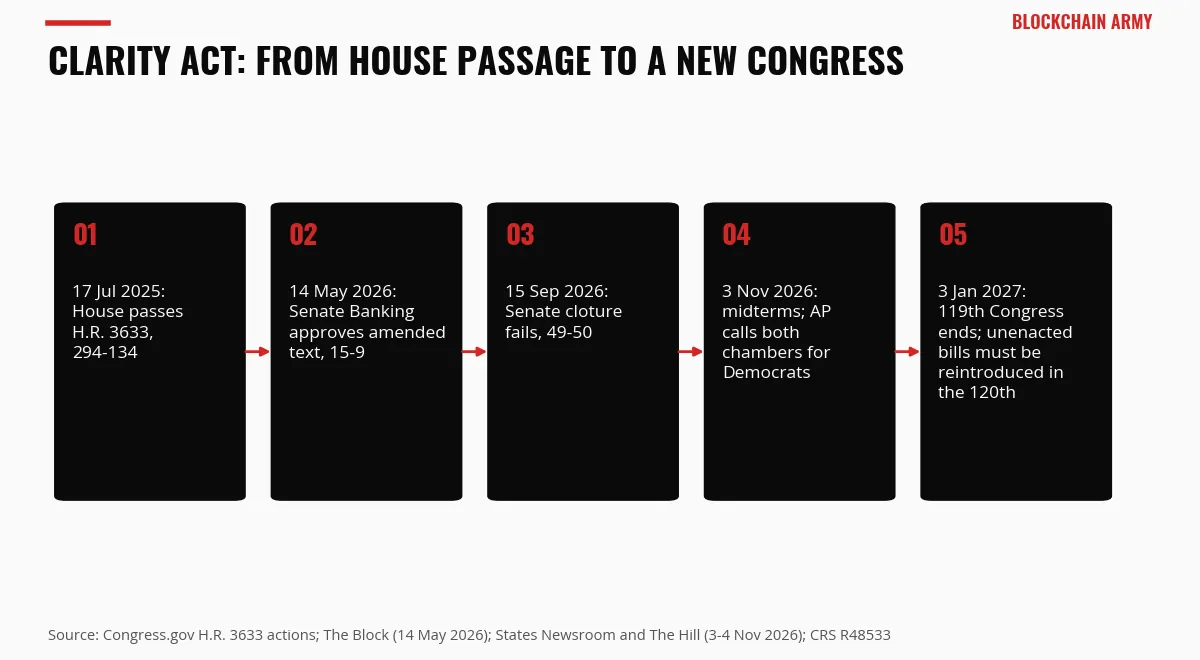
The calendar now does most of the work:
- Lame duck. The current, Republican-led Senate sits until the 119th Congress ends on 3 January 2027. Any revival would need a second cloture vote with 60 votes, Senate passage, and then House agreement to the Senate text, all in a few weeks that also have to handle year-end business.
- Reset in January. The Congressional Research Service puts it plainly: bills not enacted during a Congress "die", and further consideration requires that they be reintroduced in the next Congress. If CLARITY is not enacted by early January, a new bill would have to start again in committees with Democratic chairs.
- Ethics remains the dividing line. The September vote failed mainly over conflict-of-interest rules covering the president's crypto ventures. That issue does not go away with a change of majority.
Whether the industry gets a market-structure law in the near term now depends on whether a deal is possible before January, or on what a Warren-led Banking Committee would choose to write. Neither is predictable from the record so far, and we will not guess.
GENIUS Act: already law, on schedule
Stablecoin rules are on a different footing. The GENIUS Act was enacted in July 2025, so it does not depend on the new Congress. The OCC issued its final implementing rule on 21 October 2026, effective 18 January 2027, the Act's effective date. Treasury, FinCEN and OFAC proposals on AML, sanctions, state regimes and who may offer stablecoins in the US are still being finalised. Our GENIUS Act rulemaking explainer covers the detail.
A new majority can hold hearings and press regulators, and Fortune noted that the Banking chair's role carries subpoena and investigative power. Changing the statute itself would take new legislation and a presidential signature.
The SEC and CFTC agenda
With legislation stalled, agency rulemaking is doing most of the work. Fortune noted that the Trump-appointed heads of the SEC, CFTC and OCC remain in their posts regardless of the election. Open items as of 10 November:
| Agency | Item | Stage |
|---|---|---|
| SEC | Regulation Crypto Assets: offering exemptions (up to US$5m over four years; up to US$75m per 12 months) and an investment-contract safe harbor | Proposed 18 Aug 2026 |
| SEC | Custody rules for advisers and funds holding crypto | Proposed; Federal Register 6 Oct 2026, comments to 7 Dec |
| CFTC | Regulation Crypto Asset Transactions and Regulation Crypto Asset Markets | Advance notice; Federal Register 13 Oct 2026, comments to 14 Dec |
| OCC | GENIUS Act final rule | Effective 18 Jan 2027 |
Agency rules can be changed by later agencies and challenged in court in ways a statute cannot. That is why the industry pushed for CLARITY in the first place. For now, though, this rulemaking is the US framework.
Market context, as of early November
Two dated data points, without interpretation beyond what the sources say:
- According to SoSoValue data reported by Cointelegraph on 2 November, US spot bitcoin ETFs ended October 2026 with about US$515 million in net outflows, their first negative month since June. Year to date through October, they still showed about US$361 million in net inflows.
- The same report said US spot ether ETFs posted a record US$1.61 billion in monthly outflows in October. It linked a US$643 million single-day bitcoin ETF outflow late in the month to market volatility after Binance confirmed that hackers had stolen about US$6.3 billion in crypto assets; see our coverage of the Binance hack and hot-wallet security.
What this means for builders and teams
- Plan for no US market-structure statute in the near term, and for agency rules plus existing case law as the working framework. Revisit if a lame-duck deal appears.
- Use the comment periods. The SEC custody and CFTC advance-notice deadlines in December are the next chance to shape rules that will matter for exchanges, custodians and trading tools.
- Treat stablecoin compliance as fixed. GENIUS timelines (18 January 2027, and 18 July 2028 for service providers) are in law. Product roadmaps that integrate stablecoins should be built against them now.
- Expect more scrutiny, not less. A Democratic Senate Banking Committee is expected to focus on oversight, ethics and consumer protection. Documentation of token distribution, insider holdings, marketing claims and conflicts of interest becomes more valuable.
- Keep EU options open. For teams that need a fully legislated regime today, the EU's MiCA is live. See our note on the end of the MiCA transitional period.
If you need a roadmap that holds up across these scenarios, from token design to US and EU market entry, our advisory package is built for that kind of planning.
Sources
- States Newsroom — Democrats win sizable US House majority amid sweep of close races (3–4 Nov 2026)
- The Hill — Democrats win Senate majority (3 Nov 2026)
- Al Jazeera — Democratic Party wins US Senate in 2026 midterm elections (4 Nov 2026)
- Fortune — The crypto industry and an Elizabeth Warren-led Senate Banking Committee (9 Nov 2026)
- Congress.gov — H.R. 3633, Digital Asset Market Clarity Act: actions
- Congressional Research Service — Federal Legislative History: A Research Guide for Congressional Staff (R48533)
- The Block — Crypto's Capitol Hill champion Sen. Lummis says she won't seek re-election (19 Dec 2025)
- OCC — News release 2026-92: final rule implementing the GENIUS Act (21 Oct 2026)
- SEC — SEC proposes new Regulation Crypto Assets (press release 2026-76, 18 Aug 2026)
- Federal Register — SEC proposed rule: Adviser and Regulated Fund Custody Rules; Crypto Custody Rules (6 Oct 2026)
- Federal Register — CFTC advance notice: Regulation Crypto Asset Transactions and Regulation Crypto Asset Markets (13 Oct 2026)
- Cointelegraph — Bitcoin ETFs end October in the red (2 Nov 2026, SoSoValue data)
How we research, write and fact-check: Editorial & AI policy.
Disclaimer: this article is for informational and educational purposes only and does not constitute financial, investment, legal or tax advice. Crypto-assets are volatile and high-risk: always do your own research (DYOR) and consult a qualified professional before making any decision. Not financial advice.