

The US crypto market-structure bill hit a wall on 15 September 2026. The Senate voted 49–50 on cloture on the motion to proceed to H.R. 3633, the Digital Asset Market Clarity Act (CLARITY Act). That was 11 votes short of the 60 needed to begin debate, so the bill is stalled on the Senate floor. It is not dead in procedural terms, because Senator Thom Tillis entered a motion to reconsider, but with the midterms approaching the window for passage this year is very narrow.
What happened on 15 September
The vote was procedural. It was not a vote on the bill itself, only on whether to end debate on taking it up. According to the official Congress.gov record (Senate Record Vote No. 234), cloture was "not invoked" by 49–50. Some early reports gave the tally as 50–49; the official record shows 49 in favour.
All 49 yes votes came from Republicans. The Defiant reported that four Republicans, Susan Collins, Josh Hawley, Jerry Moran and Thom Tillis, voted no. Tillis voted no to keep the right to move to reconsider under Senate rules, and Congress.gov records that he entered that motion the same day. That leaves a route for another cloture vote if leadership finds the votes and the floor time.
The more telling votes were on the Democratic side. The Block reported that Democrats who have backed crypto legislation in the past, including Kirsten Gillibrand, Catherine Cortez Masto, Angela Alsobrooks, Cory Booker and Mark Warner, voted no.
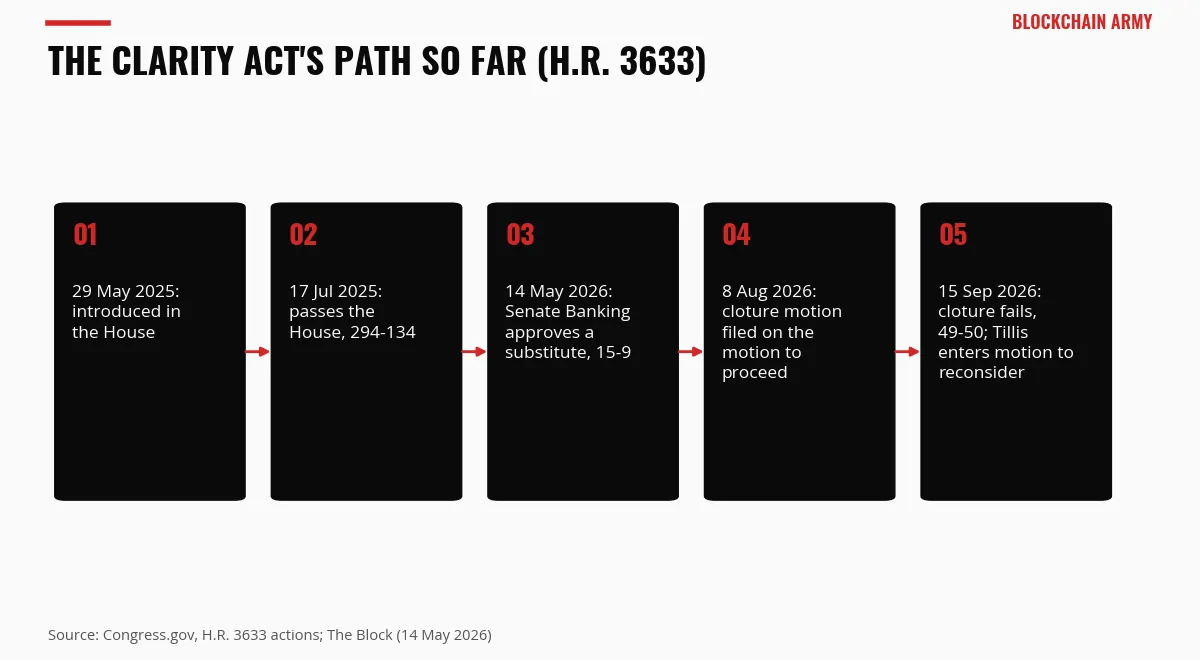
How the bill got here
| Date | Step |
|---|---|
| 29 May 2025 | H.R. 3633 introduced in the House |
| 17 July 2025 | Passed the House, 294–134 |
| 18 Sep 2025 | Received in the Senate, referred to Banking |
| 14 May 2026 | Senate Banking approves an amended version, 15–9 |
| 1 June 2026 | Reported to the Senate with a substitute text |
| 8 Aug 2026 | Motion to proceed and cloture motion filed |
| 15 Sep 2026 | Cloture fails, 49–50 |
At the 14 May markup, two Democrats, Ruben Gallego and Angela Alsobrooks, joined committee Republicans. Gallego said at the time that he would vote no on the floor unless ethics language on conflicts of interest was resolved, according to The Block. Four months later, that condition was still the core problem.
Why it stalled: the ethics fight
The main sticking point was conflict-of-interest rules for senior officials, focused on President Donald Trump's crypto holdings. The Block described his crypto wealth as having grown to hundreds of millions of dollars through World Liberty Financial and the TRUMP memecoin.
Senator Cynthia Lummis, the bill's lead Republican architect, offered revised ethics text. According to The Block, it would have let state attorneys general sue, and required officials to divest a "significant financial interest" or place it in a blind trust. Democrats argued it would be unenforceable against the president in practice. They countered with broader restrictions, including coverage of the president's children. Lummis rejected that offer.
Senator Warner explained his vote this way: "the failure to address this fundamental conflict of interest made it impossible for me to support moving forward."
Ethics was not the only open issue. The Block also pointed to the unresolved fight between banks and crypto firms over stablecoin rewards, and to lingering illicit-finance concerns.
What is actually in the bill
The Senate substitute differs from the House text in many details, but the architecture is the same. Based on the Congressional Research Service summary of the House-passed version:
- SEC/CFTC split. The CFTC would get exclusive jurisdiction over transactions in "digital commodities", including spot markets, on registered platforms. Exchanges, brokers and dealers would register with the CFTC. The SEC would keep authority over primary-market fundraising and over trading by SEC-registered firms.
- Digital commodity. Defined as a digital asset whose value is "intrinsically linked" to the use of its blockchain, excluding securities, derivatives and stablecoins.
- Mature blockchain. A blockchain system "not controlled by any person or group of persons under common control". Among other criteria, it would cap ownership by certain holders at under 20% of outstanding units. Issuers could certify maturity to the SEC, and exchanges could list only tokens on mature chains or tokens whose issuers file ongoing reports.
- Fundraising exemption. A new exemption from SEC registration for token sales on mature blockchains, capped at US$75 million over 12 months, with an offering statement.
- DeFi. Activities such as validating would be excluded from the bill's requirements, but not from anti-fraud and anti-manipulation authority.
- Exchange rules. Core principles, no commingling of customer assets, Bank Secrecy Act coverage, and a provisional registration regime until rules are written.
The Senate Banking version also carried the Blockchain Regulatory Certainty Act, which says non-custodial developers are not money transmitters. A compromise added language allowing criminal liability where a developer acts with "specific intent", according to The Block.
What happens next
Three facts frame the outlook as of 18 September 2026.
- Floor time is scarce. The Block reported that lawmakers are heading into recess ahead of the November midterms, and that the House cancelled its last two weeks of September. Even if the Senate passed a version, the House would need to vote again on the Senate text.
- The clock runs out in January. Bills not enacted by the end of the 119th Congress would have to be reintroduced and start over in the 120th.
- Regulators are not waiting. SEC Chair Paul Atkins, quoted by The Block on the day of the vote, said: "Promises were made, and they will be kept." The SEC proposed "Regulation Crypto Assets" on 18 August 2026. It includes a one-time exemption of up to US$5 million over four years, a second exemption of up to US$75 million per 12 months, and a conditional safe harbor under which a crypto asset would not be treated as subject to an investment contract. That followed a March 2026 SEC interpretation, with CFTC guidance, on how securities laws apply to certain crypto assets.
Scott Kimpel of Hunton Andrews Kurth summed up the near-term view on 16 September: "in the near term the CLARITY Act is effectively dead," with "meaningful regulatory progress" more likely to come through agency action.
What this means for builders
For teams building tokens, exchanges, DeFi front ends or trading tools with US exposure, the practical read is:
- Plan around rulemaking, not legislation. For the coming months, the SEC's proposed exemptions and safe harbor, and any CFTC action, are more likely to define the rules than a statute. Track comment deadlines and consider commenting through a trade association.
- Design for decentralisation evidence anyway. The "mature blockchain" concept, with control tests and concentration limits, has appeared in every serious draft. Documenting governance, admin-key removal and token distribution is useful under any outcome.
- Keep token allocations defensible. A 20% ownership threshold and offering caps can shape tokenomics. Model allocations, vesting and treasury holdings so they can be explained to a regulator.
- Separate developer and operator roles. Non-custodial developer protections are still contested. Keep a clean line between writing software and controlling user funds.
- Do not market on the assumption of a bill. Claims that a token "will be a commodity under CLARITY" are speculation until something is enacted.
Stablecoin rules are on a separate track. The GENIUS Act is already law and its implementing rules are being written; see our earlier analysis of the GENIUS Act and Treasury risk. For EU-facing projects, the regime is already live: read our piece on the end of the MiCA transitional period.
If you need to map a launch or product roadmap against both the US and EU regimes, that is the kind of work our advisory package covers.
Sources
- Congress.gov — H.R. 3633, Digital Asset Market Clarity Act: actions
- Congressional Research Service — Crypto Legislation: An Overview of H.R. 3633, the CLARITY Act (IN12583)
- The Block — Clarity Act preliminary vote falls short in Senate amid ethics fight over Trump's crypto wealth (15 Sep 2026)
- The Defiant — Senate blocks CLARITY Act 49-50 with no Democratic votes to proceed (15 Sep 2026)
- The Block — Senate Banking Committee advances landmark crypto market structure bill (14 May 2026)
- National Law Review (Hunton Andrews Kurth) — Senate fails to advance CLARITY Act (16 Sep 2026)
- SEC — SEC proposes new Regulation Crypto Assets (press release 2026-76, 18 Aug 2026)
- Federal Register — Application of the Federal Securities Laws to Certain Types of Crypto Assets (SEC interpretation, CFTC guidance, 23 Mar 2026)
How we research, write and fact-check: Editorial & AI policy.
Disclaimer: this article is for informational and educational purposes only and does not constitute financial, investment, legal or tax advice. Crypto-assets are volatile and high-risk: always do your own research (DYOR) and consult a qualified professional before making any decision. Not financial advice.