

MiCA's last safety net is gone. The transitional period that let crypto firms keep serving EU clients under old national registrations ended across the whole EU on 1 July 2026, and since then any entity providing crypto-asset services to EU clients without a MiCA licence is, in ESMA's words, "in breach of EU law". For token projects, the practical consequence is a marketing one: who you promote through, what you publish first and what your posts may say are now regulated questions, not style choices.
What ended on 1 July 2026
The Markets in Crypto-Assets Regulation (Regulation (EU) 2023/1114) has applied in full since 30 December 2024. Article 143(3) gave crypto-asset service providers (CASPs) that were already operating under national law a grace period of up to 18 months, until 1 July 2026, to obtain authorisation. Member States could shorten it or not apply it at all, and some did.
ESMA's statement of 17 April 2026 removed any doubt about the end date. It said the transitional period "will officially expire across the EU on 1 July 2026", that unauthorised CASPs had to have executed their wind-down plans by then, and that this applies whether or not a Member State had finished adapting its national law. It also reminded the market that firms established outside the EU may not provide MiCA services to EU investors, or solicit EU clients, "outside the narrow exception of reverse solicitation", including in business-to-business arrangements.
A second ESMA statement on 23 June 2026, relayed by France's AMF, was more operational. Unauthorised CASPs must stop onboarding new EU clients, stop marketing to and soliciting EU clients, and limit remaining activity to helping existing clients sell, transfer or close positions. ESMA also told consumers to check providers against its interim MiCA register before investing or moving funds.
Who is actually authorised
There is no single headline number, because the register changes weekly. ESMA's interim register file for CASPs combines two kinds of entries: firms authorised as CASPs under Article 63, and existing financial institutions such as banks and investment firms that notified their crypto services under Article 60. Counting entries in that file with an authorisation or notification date up to 14 September 2026 gives roughly 350, spread across 28 EU and EEA states, with Germany clearly in front.
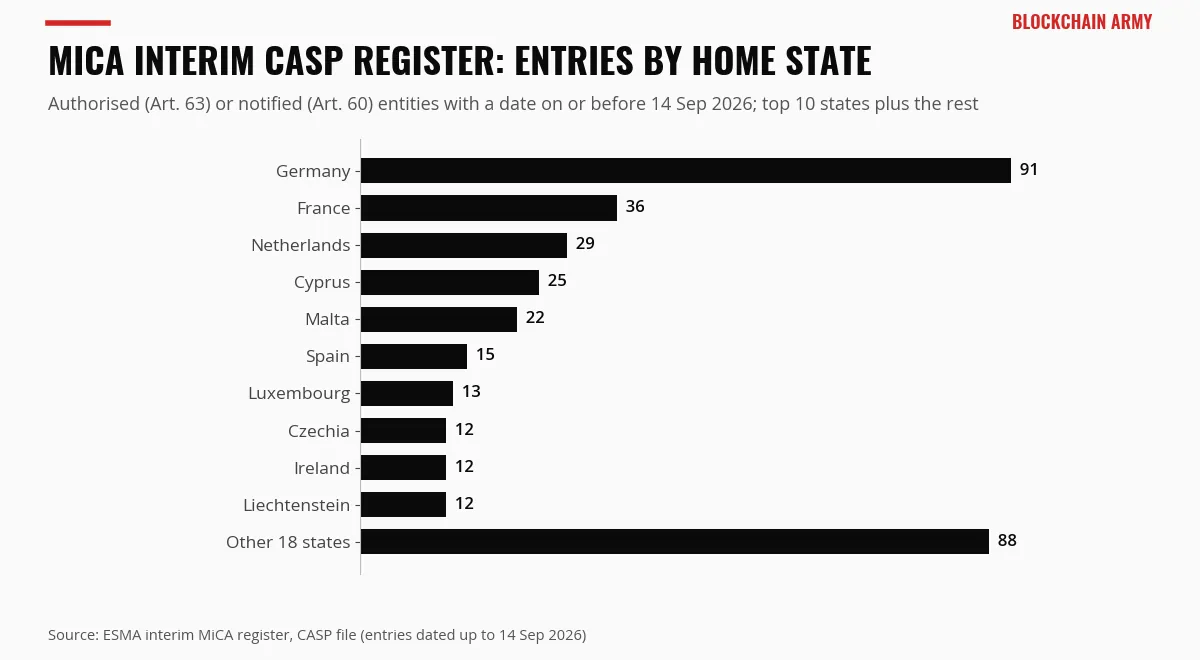
Two caveats matter. An Article 60 entry is a bank or investment firm adding crypto services, not a crypto-native exchange. And MiCA protections attach to the specific authorised legal entity. ESMA explicitly warned that a group may trade under one brand across several companies, and only the EU-authorised entity is covered.
The marketing rules that now bite
MiCA regulates crypto marketing at two levels: the asset being promoted and the firm doing the promoting.
Rules by asset type
| MiCA title | Asset | Disclosure document | Marketing article |
|---|---|---|---|
| Title II | Other crypto-assets (most utility and governance tokens) | Crypto-asset white paper (Arts. 4–6, notified under Art. 8) | Article 7 |
| Title III | Asset-referenced tokens (ARTs) | ART white paper, approved with issuer authorisation | Article 29 |
| Title IV | E-money tokens (EMTs) | EMT white paper | Article 53 |
For the tokens most projects issue, Article 7 is the one to know. Marketing communications for an offer to the public or an admission to trading must:
- be clearly identifiable as marketing;
- be fair, clear and not misleading;
- be consistent with the white paper;
- state that a white paper has been published and give the offeror's website, phone number and email;
- carry a prominent statement that no EU competent authority has reviewed or approved the communication and that the offeror is solely responsible for it.
Article 7(2) adds a timing rule that catches many launch plans: where a white paper is required, no marketing communication may be disseminated before the white paper is published. Market soundings are not affected, but a teaser campaign promising an EU token sale is.
The white paper is required for offers to the public and admissions to trading unless an exemption in Article 4 applies (for example, offers to fewer than 150 persons per Member State, offers totalling no more than EUR 1 million over 12 months, or offers only to qualified investors). It has to be notified to the national competent authority before publication. For background on what a white paper should contain, see our guide to what a white paper is.
Rules for service providers
Article 66 sits on top of the asset rules for authorised CASPs. They must act honestly, fairly and professionally in the best interests of clients. Under Article 66(2), all information they give clients, including marketing communications, must be fair, clear and not misleading, and marketing must be identified as such. CASPs may not mislead clients, deliberately or negligently, about the real or perceived advantages of any crypto-asset. When an exchange or broker lists or promotes a token, it carries its own liability for how that token is presented.
Who can promote to EU users now
This is where the end of the transition changes day-to-day work for project teams.
- Exchanges and brokers. Only firms authorised under Article 63, or institutions notified under Article 60, may provide crypto-asset services to EU clients. A partnership campaign with an unauthorised offshore venue that targets EU users is now promotion of an illegal service in the EU.
- Reverse solicitation is narrow. A non-EU firm may serve an EU client only at that client's own exclusive initiative, and the exception does not let the firm market other crypto-assets or services to them. Geo-targeted ads, EU-language landing pages and affiliate links aimed at EU users are hard to reconcile with it.
- Influencers and KOLs. MiCA has no influencer-specific article, but a paid post about an offer or admission to trading is a marketing communication. It must be identifiable as marketing and consistent with the white paper, and it cannot run before the white paper is published. National consumer and advertising rules apply on top.
- The issuer remains responsible. The Article 7 disclaimer says the offeror is solely responsible for the content. Outsourcing a campaign to an agency or creator does not outsource that responsibility.
The older background on how MiCA was adopted is in our earlier piece on EU officials signing the MiCA framework into law.
What this means for token projects and marketing teams
For teams launching or promoting a token with EU reach, a practical checklist:
- Classify the token first. Decide, with counsel, whether it is an "other" crypto-asset, an ART or an EMT, or out of scope (for example, genuinely unique NFTs). Every later step depends on it.
- Sequence the white paper before the campaign. If a white paper is required, publish it, after notifying your competent authority, before any public marketing that references the offer or listing. Build that into the launch calendar.
- Write every marketing asset against the white paper. Supply figures, token allocations, vesting and use-of-funds language should match it word for word where possible. Keep a version log.
- Add the mandatory statements. Use a standard footer or pinned disclosure for posts, threads, videos and landing pages, with the white paper link, contact details and the "not reviewed or approved" statement.
- Label paid content. Sponsored threads, KOL posts and AMAs paid for by the project should be marked as marketing.
- Check every venue and partner against the register. Before announcing a listing, launchpad or "trade now" partner to EU users, confirm the exact legal entity appears in ESMA's interim register.
- Geo-fence when in doubt. If an offer or partner is not MiCA-ready, exclude EU users from targeting and from the funnel. Do not rely on reverse solicitation as a marketing strategy.
- Keep records. Competent authorities in the Member States where communications are disseminated can check compliance, so keep copies, dates and targeting settings.
None of this stops a project from marketing in Europe. It changes the order of operations: legal classification and disclosures first, creative second. If you are planning an EU-facing launch and want the campaign built around those constraints from day one, our general marketing strategy work starts from exactly that sequence.
Sources
- ESMA — Statement on the end of transitional periods under MiCA (17 April 2026)
- ESMA — Public statement: MiCA transitional period ends (23 June 2026)
- AMF — ESMA calls on unauthorised crypto-asset service providers to wind down orderly (23 June 2026)
- ESMA Interactive Single Rulebook — MiCA Article 7: Marketing communications
- ESMA Interactive Single Rulebook — MiCA Article 66: Obligation to act honestly, fairly and professionally
- ESMA — Interim MiCA register (CASP file)
- ESMA Interactive Single Rulebook — MiCA Article 4: Offers to the public of crypto-assets
- ESMA Interactive Single Rulebook — MiCA Article 143: Transitional measures
How we research, write and fact-check: Editorial & AI policy.
Disclaimer: this article is for informational and educational purposes only and does not constitute financial, investment, legal or tax advice. Crypto-assets are volatile and high-risk: always do your own research (DYOR) and consult a qualified professional before making any decision. Not financial advice.