


The GENIUS Act now has its main federal rulebook. On 21 October 2026 the Office of the Comptroller of the Currency (OCC) issued its final rule for stablecoin issuers under its supervision, published in the Federal Register on 23 October and effective on 18 January 2027, the same day the Act itself takes effect. Treasury, FinCEN and OFAC have proposed the rest of the framework, covering AML, sanctions, state regimes and who may offer stablecoins in the US, so the picture for issuers, exchanges and dApps is now much clearer.
Where the rulemaking stands
The GENIUS Act was enacted on 18 July 2025. It leaves many details to regulators, and 2026 has been the year those details were written. The main federal documents so far:
| Date (Federal Register) | Agency | Document | Status as of 26 Oct 2026 |
|---|---|---|---|
| 2 Mar 2026 | OCC | Proposed rule for OCC-supervised issuers and custody | Superseded by final rule |
| 3 Apr 2026 | Treasury | "Broad-based principles" for when a state regime is "substantially similar" | Proposed; comments closed 2 June |
| 10 Apr 2026 | FinCEN and OFAC | AML/CFT and sanctions compliance programs for permitted issuers | Proposed; comments closed 9 June |
| 18 Aug 2026 | Treasury | Rules on issuance, offer and sale of payment stablecoins (section 3) | Proposed; comments closed 19 Oct |
| 30 Sep 2026 | Treasury | Procedures for the Stablecoin Certification Review Committee | Interim final rule; comments to 30 Nov |
| 23 Oct 2026 | OCC | Final rule | Effective 18 Jan 2027 |
Other regulators have their own proposals for the issuers they supervise, including the FDIC, the NCUA and the Federal Reserve. In June 2026 the OCC also proposed a separate BSA/AML and sanctions rule for its issuers.
What the OCC final rule decides
The OCC received about 328 comments on its March proposal. According to the final rule, the most contested topics were reserve management, the yield prohibition, redemption and capital. The final rule settled them as follows.
Yield: statutory ban kept, presumption dropped
The Act prohibits a permitted issuer from paying interest or yield to holders "solely in connection with the holding, use, or retention" of the stablecoin. The March proposal added a rebuttable presumption that certain payments through affiliates and related third parties violated the ban.
The final rule drops that presumption. The OCC also declined to define "interest" or "yield", saying it will apply statutory interpretation to the facts of each case. Two limits remain:
- An issuer that pays an agent or another entity to make a yield payment it could not make directly would, in the OCC's words, "clearly evade" the prohibition. The OCC says it keeps its anti-evasion authority.
- Payments that are not made "solely" in connection with holding the stablecoin are outside the prohibition by the Act's own terms. Payments through intermediaries are judged on the facts.
The rule applies the ban equally to retail and institutional holders.
Reserves: 1:1, published monthly
Issuers must keep identifiable reserves backing outstanding stablecoins on at least a 1 to 1 basis, in the asset types the Act permits. The rule implements the Act's monthly reserve composition report on the issuer's website, with the prior month-end report examined by a registered public accounting firm. It also approves, for all OCC-regulated issuers, repurchase agreements using Treasury bills with a maturity of 93 days or less.
Redemption: two business days
The rule defines "timely" redemption: an issuer must generally redeem no later than two business days after the request. Issuers may redeem faster. The rule does allow for an extension of that period in some cases, though many commenters had argued against freezes or extensions during a spike in requests, warning they could accelerate a run.
Who may offer stablecoins in the US
Treasury's August proposal implements section 3 of the Act, which decides which stablecoins can be offered to US users. Three points matter for builders:
- Only permitted issuers may issue. It is unlawful for anyone other than a permitted payment stablecoin issuer to issue a payment stablecoin in the United States.
- From 18 July 2028, intermediaries are covered too. A "digital asset service provider", broadly an exchange, custodian or transfer service operating for compensation, may not offer or sell a payment stablecoin to a person in the US unless a permitted issuer issued it. A separate rule for foreign issuers applies from the Act's effective date.
- Self-custody is carved out. Section 3 does not cover direct transfers between two individuals acting for themselves without an intermediary, or transactions using a software or hardware wallet that lets an individual hold their own assets.
FinCEN and OFAC's April proposal would treat permitted issuers as financial institutions under the Bank Secrecy Act, require AML/CFT programs and require effective sanctions compliance programs.
The market these rules will govern
Stablecoin supply grew quickly in 2025 and then flattened. DefiLlama data shows USD-pegged stablecoins in circulation rising from about US$203 billion on 1 January 2025 to about US$302 billion a year later. In 2026 the monthly data points stayed between about US$296 billion and US$311 billion, and supply stood at about US$300 billion on 25 October 2026.
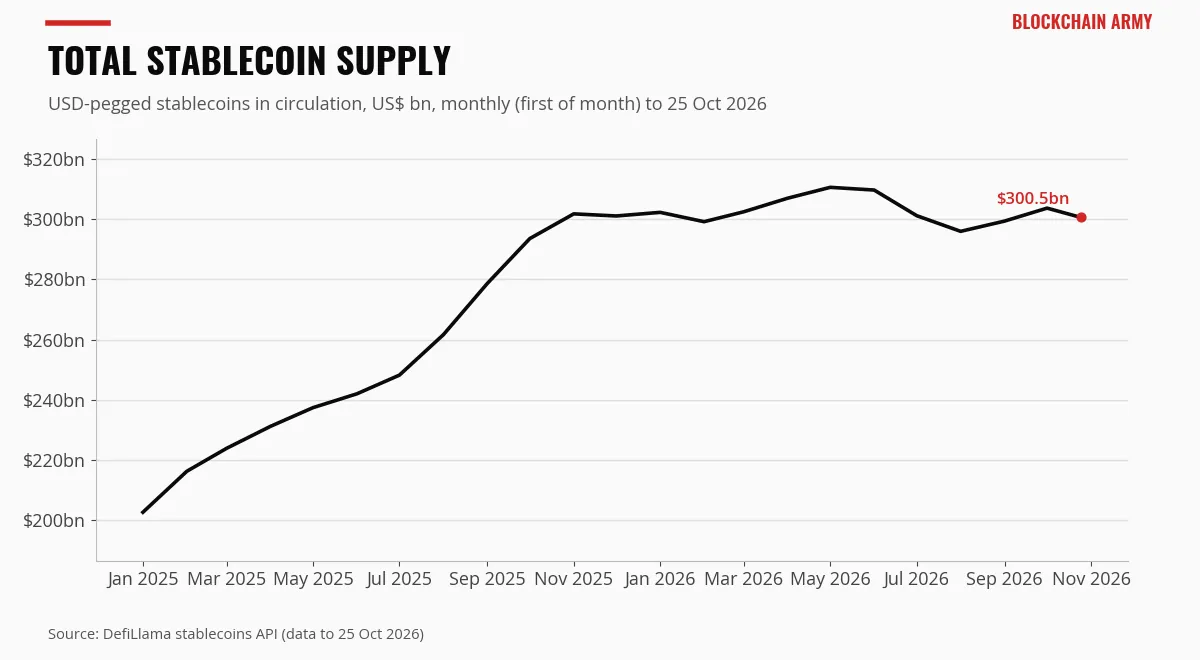
The GENIUS Act was signed when supply was about US$255 billion (DefiLlama, 18 July 2025). The rules now being finalised will govern a market of around US$300 billion.
What this means for dApps and DeFi teams
GENIUS regulates issuers, and section 3 reaches service providers. Most dApps are neither, but the rules change the stablecoins they integrate and the features they can safely build around them.
Yield features. The ban is on the issuer paying holders for simply holding. It does not, by its terms, reach DeFi yield from lending, liquidity provision or trading, which comes from protocol activity rather than the issuer. Avoid designs where an issuer, or its agent, funds "rewards" that are really pass-through interest. That is the pattern the OCC said would "clearly evade" the ban. If an issuer offers a partnership with incentive payments, ask what they are paid for.
Redemption assumptions. A two-business-day outer limit on redemption is a policy, not a peg guarantee. Liquidation engines, vault accounting and oracle fallbacks should still handle secondary-market depegs, and should not assume on-chain liquidity equals redemption at par.
Asset lists after mid-2028. If your front end, wallet or aggregator could be a "digital asset service provider" for US users, plan for 18 July 2028. After that, only stablecoins from permitted issuers can be offered or sold to US persons through such providers. Build token allow-lists that can be switched per jurisdiction, and record which issuer stands behind each stablecoin you support.
Compliance hooks. Permitted issuers will run AML and sanctions programs, so token-level freezes and blocklists are a realistic case to design for. Contracts that hold stablecoins in pooled custody should handle a frozen balance without bricking the pool.
Transparency data. Monthly reserve reports will be public. For teams building dashboards and analytics, issuer disclosures will sit next to on-chain supply. Our DEXTools burn dashboard case study shows the kind of off-chain plus on-chain tracking that approach needs.
If you are integrating stablecoins into a dApp and want the contract and front-end architecture reviewed against these rules, see our Web3 apps service. For the background, read our earlier take on the GENIUS Act and Treasury risk and our technical guide to creating a stablecoin on Ethereum. The market-structure bill that would have covered the rest of crypto is a separate story: see why the CLARITY Act stalled in the Senate.
Sources
- OCC — News release 2026-92: OCC issues final rule implementing the GENIUS Act (21 Oct 2026)
- Federal Register — OCC final rule implementing the GENIUS Act (91 FR 67000, 23 Oct 2026)
- Federal Register — OCC proposed rule implementing the GENIUS Act (91 FR 10202, 2 Mar 2026)
- Federal Register — FinCEN/OFAC proposed rule: PPSI AML/CFT and sanctions compliance programs (91 FR 18582, 10 Apr 2026)
- Federal Register — Treasury proposed broad-based principles for state regimes (91 FR 16844, 3 Apr 2026)
- Federal Register — Stablecoin Certification Review Committee interim final rule (91 FR 61688, 30 Sep 2026)
- Federal Register — Treasury proposed rule: GENIUS Act regulations on payment stablecoin issuance, offer and sale (91 FR 53368, 18 Aug 2026)
- DefiLlama — Stablecoins: total circulating (API)
How we research, write and fact-check: Editorial & AI policy.
Disclaimer: this article is for informational and educational purposes only and does not constitute financial, investment, legal or tax advice. Crypto-assets are volatile and high-risk: always do your own research (DYOR) and consult a qualified professional before making any decision. Not financial advice.