
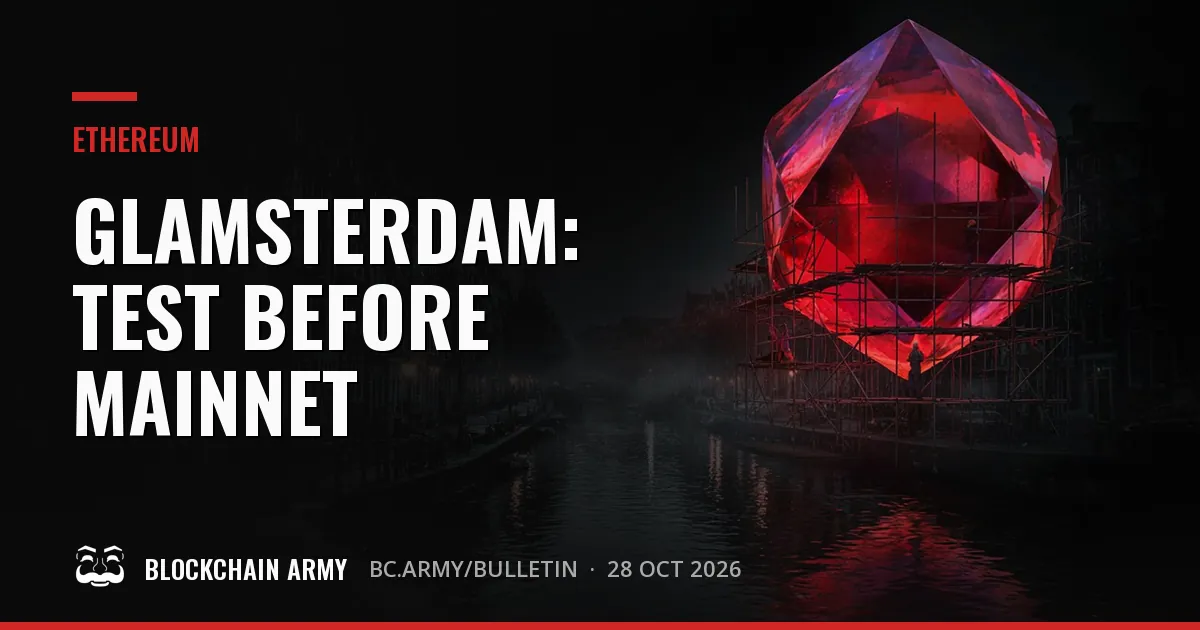
Ethereum's next hard fork, Glamsterdam, has been live on the Sepolia testnet since 6 October 2026, but its planned 26 October activation on Hoodi was postponed on 22 October and, as of 28 October 2026, has no new date. There is no mainnet date either. For dApp and smart-contract teams, the delay is useful time: Glamsterdam reprices gas in ways that can change how existing contracts behave, without any change to their code.
Where the upgrade stands
Glamsterdam combines the Amsterdam execution-layer upgrade with the Gloas consensus-layer upgrade. Its scope and activation table live in the meta EIP, EIP-7773.
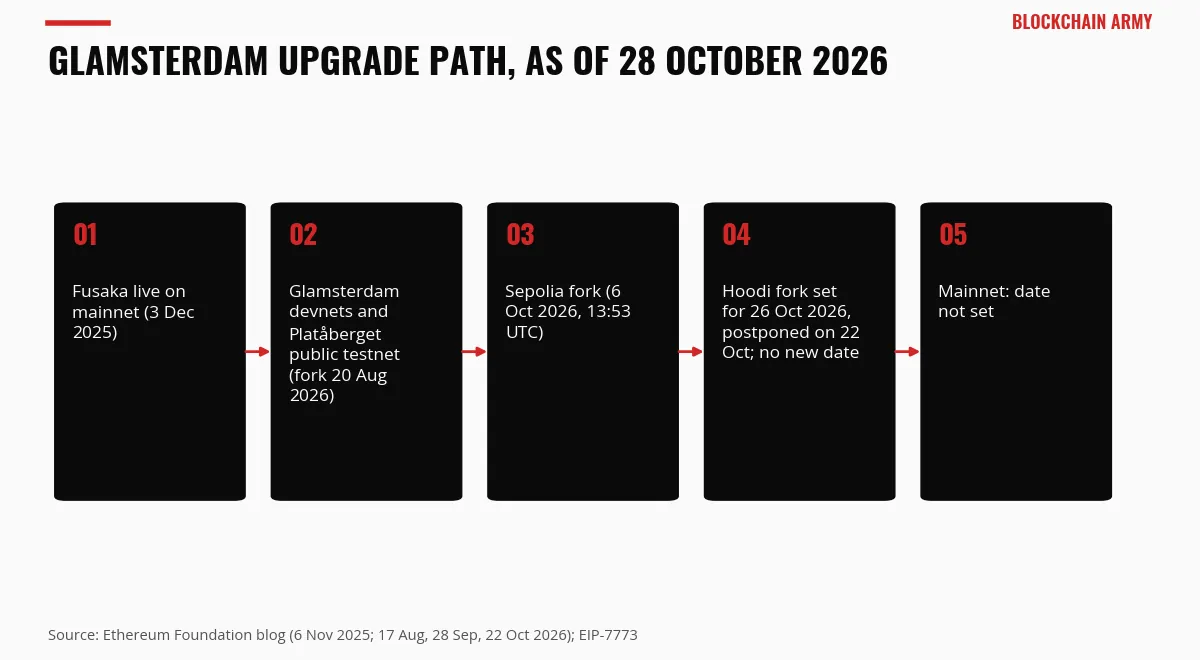
| Milestone | Status as of 28 October 2026 |
|---|---|
| Fusaka on mainnet | Activated 3 December 2025 |
| Platåberget public testnet | Glamsterdam fork scheduled 20 August 2026; meant to run for a few months |
| Sepolia | Activated 6 October 2026, 13:53:36 UTC (epoch 353,024) |
| Hoodi | Scheduled for 26 October 2026, 17:42:48 UTC; postponed on 22 October, no new date |
| Mainnet | Not scheduled |
The Ethereum Foundation said core developers decided at All Core Devs Execution call #248 to delay Hoodi "to allow for further investigation of interactions of EIP-8037 with mainnet smart contracts." The postponement removed the scheduled Amsterdam and Gloas activations on Hoodi and a planned gas-limit increase to 200 million. The EF told application developers not to plan Hoodi testing around a 26 October activation and said a revised schedule would be announced separately. According to Bankless, Nixo, a co-author of the Glamsterdam meta EIP, said the delay was expected to push mainnet into 2027; that is an expectation, not a decision.
What is in scope
EIP-7773 lists 18 EIPs as Scheduled for Inclusion. The ones most relevant to application teams:
| EIP | Change | Why dApp teams care |
|---|---|---|
| EIP-7732 | Enshrined proposer-builder separation (ePBS) | Changes block production and builder infrastructure; relevant to MEV-aware apps and infra providers |
| EIP-7928 | Block-level access lists | Blocks record the accounts and storage they touch, enabling parallel validation; groundwork for higher throughput |
| EIP-2780 | Resource-based intrinsic transaction gas | A plain ETH transfer to an existing account stays 21,000 gas; transfers that create a new account pay extra at runtime |
| EIP-8037 | State creation gas cost increase | New state (storage slots, accounts) costs much more; the cause of the Hoodi delay |
| EIP-8038 | State-access gas cost update | Storage and account access are repriced |
| EIP-7976 / EIP-7981 | Higher calldata floor and access-list costs | Data-heavy transactions and access-list strategies may cost more |
| EIP-7778 | Block gas accounting without refunds | Refunds still reduce what users pay but no longer count against the block gas limit |
| EIP-7954 | Maximum contract size from 24 KiB to 64 KiB; initcode from 48 KiB to 128 KiB | Larger contracts become deployable; tooling limits need updating |
| EIP-7708 | ETH transfers emit a log | Indexers and accounting tools can track ETH movements through logs |
| EIP-7997 | Deterministic factory contract | A standard CREATE2 factory address across EVM chains for same-address deployments |
| EIP-8246 | Remove SELFDESTRUCT burn | Remaining cases where SELFDESTRUCT burns ETH are removed; balances are preserved |
Several of these EIPs were still in Last Call at the end of October, so details can change, and any change to EIP-8037 could require new client releases and, according to Bankless, possibly another fork on Sepolia.
Why the gas changes matter
The core issue is simple to state: contracts written with fixed gas assumptions may behave differently after the repricing.
Security firm ChainSecurity published research on 13 October 2026 showing that under EIP-8037 and EIP-8038, a cold write to a fresh storage slot can cost 110,020 execution gas when the new state-gas reservoir cannot cover it, compared with 22,100 gas today. The risk is not only higher fees. Code paths that used to run out of gas and revert can now complete, and code that used to complete can now fail. ChainSecurity highlights "insufficient gas griefing", where a caller deliberately supplies just enough gas for an operation to fail and be recorded as failed, potentially blocking a legitimate retry.
The EF's Sepolia announcement put it directly: contracts "that rely on fixed gas stipends, hardcoded gas limits, or assumptions about remaining gas may need changes." Its Platåberget post warned that tools relying on a hardcoded maximum gas limit will break, naming wallets, indexers and gas estimators.
A practical checklist for dApp and smart-contract teams
1. Inventory gas assumptions in contracts. Search for hardcoded gas values in call, fixed forwarding amounts, post-call gasleft() checks, and logic that treats an out-of-gas revert as a safety guard. ChainSecurity recommends recalculating failure-handler costs under both the current (Osaka) and Glamsterdam schedules and propagating failures instead of making irreversible decisions based on remaining gas.
2. Test on Sepolia now. Sepolia already runs Glamsterdam rules. Deploy your contracts, run your integration suite and compare gas usage and outcomes against mainnet behaviour. Do not wait for Hoodi.
3. Update off-chain gas logic. Relayers, bundlers, keepers, bots and backends often set gas limits by hand. Anything that assumes 21,000 gas covers every ETH transfer, or that a single gas dimension describes a transaction, needs review. This includes trading bots and DEX tooling that pre-compute gas.
4. Check tooling and client versions. Compilers, frameworks, local nodes and simulators need Glamsterdam support to give you accurate results. If you run your own nodes, track client release notes closely; the EF told Hoodi operators to use releases that explicitly confirm the 26 October activation was removed.
5. Ask your infrastructure providers. RPC providers, indexers, block explorers and wallet SDKs will roll out support on their own timelines. Confirm their plans for Sepolia and Hoodi and for the new ETH transfer logs.
6. Revisit contract size workarounds. EIP-7954 raises the size limit to 64 KiB. That does not mean you should merge everything into one contract; keep upgrade and audit boundaries clear, and do not deploy anything relying on the new limit to mainnet before the fork.
7. Plan monitoring for the fork. Once a mainnet date exists, set alerts on failed transactions, gas usage per function and keeper or relayer errors for the days around activation. Dashboards that track on-chain behaviour, like the DEXTools burn dashboard we built, are easier to adapt when the data pipeline is already in place.
8. Get a second pair of eyes. If your contracts use gas-sensitive patterns, include Glamsterdam behaviour in your next review. The EF has asked projects that may be affected to contact glamsterdam@ethereum.org. Our smart contract development team can help with the inventory and tests, and our smart contract audit checklist covers what to prepare before a review.
The bottom line
As of 28 October 2026, Glamsterdam is running on Sepolia, the Hoodi fork is postponed while developers study EIP-8037, and there is no mainnet date. The upgrade brings real long-term benefits, from ePBS to block-level access lists, but its gas changes are the part most likely to affect live applications. Use the extra time to test on Sepolia, remove hardcoded gas assumptions and confirm your tooling is ready. For background on the previous upgrades, see our piece on Fusaka and Pectra.
Sources
- Ethereum EIPs — EIP-7773: Hardfork Meta - Glamsterdam
- Ethereum Foundation blog — Glamsterdam testnet announcement (28 September 2026)
- Ethereum Foundation blog — Glamsterdam on Hoodi postponed (22 October 2026)
- Ethereum Foundation blog — Platåberget testnet (17 August 2026)
- Ethereum Foundation blog — Fusaka mainnet announcement
- ChainSecurity — Glamsterdam gas changes and failure handlers (13 October 2026)
- Cointelegraph — Ethereum's Glamsterdam upgrade launches on Sepolia testnet (6 October 2026)
- Bankless — Ethereum devs postpone Glamsterdam on Hoodi over contract security risks (23 October 2026)
- Ethereum EIPs — EIP-7954: Increase Maximum Contract Size
- Ethereum EIPs — EIP-2780: Resource-Based Intrinsic Transaction Gas
How we research, write and fact-check: Editorial & AI policy.
Disclaimer: this article is for informational and educational purposes only and does not constitute financial, investment, legal or tax advice. Crypto-assets are volatile and high-risk: always do your own research (DYOR) and consult a qualified professional before making any decision. Not financial advice.