
Most tokens that launched with real scale over the past two and a half years are worth less today than at their token generation event (TGE). As of 21 July 2026, CryptoRank counted only 8 of 113 tokens launched since 2024 with a market cap above $100 million still trading above their TGE price, with a median return of about -95.7%. The data points less to bad luck than to repeatable design problems: thin float, heavy unlock schedules and launch plans that spend their attention budget on day one.
What the CryptoRank data shows
CryptoRank published the figures on 21 July 2026 on its news feed and X account; the numbers were reported the same day by outlets including CryptoPotato and AMBCrypto. The sample covers 113 projects launched from 2024 onwards with a market capitalization above $100 million at the time of the study, spanning DeFi, gaming and infrastructure.
| Metric (CryptoRank, 21 July 2026) | Value |
|---|---|
| Tokens in sample (launched since 2024, market cap > $100m) | 113 |
| Trading above TGE price | 8 (7.1%) |
| Trading below TGE price | 105 (92.9%) |
| Median return since TGE | about -95.7% |
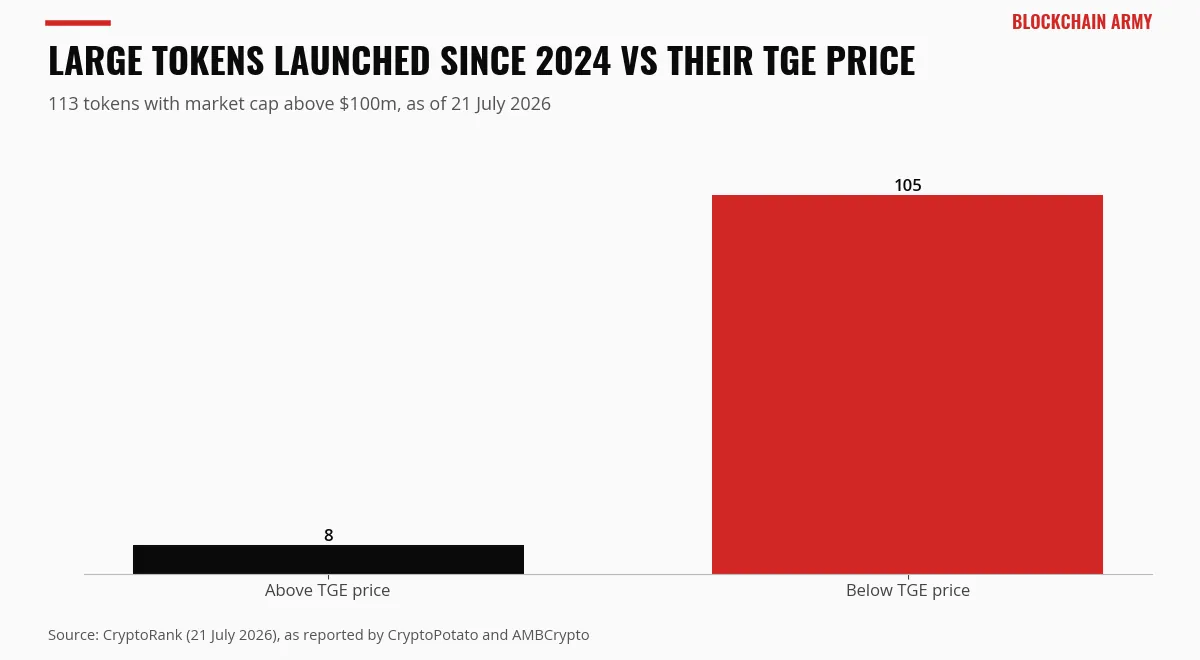
The reported winners are a short list. Hyperliquid (HYPE) led at roughly +1,519%, followed by Ondo Finance (ONDO) at about +101%, EverValue Coin (EVA) at about +20% and Midnight (NIGHT) at about +16.5%, according to the coverage. The remaining four were not named in the reports we reviewed.
Two caveats matter. First, the sample only includes tokens that still have a market cap above $100 million, so it leaves out the long tail of smaller launches, which would likely make the picture worse rather than better. Second, "TGE price" is the first traded price, not what seed or private investors paid. Early backers can be in profit on a token that has fallen 80% from listing. That gap is part of the problem.
Why launches keep repeating the same pattern
Low float, high FDV
Many launches put a small share of total supply into circulation at TGE while pricing the token on its fully diluted valuation (FDV). A small float can push the opening price up because there is little supply to trade, but it also means most of the supply is still to come. Every later unlock adds sellers into a market that was priced on scarcity.
Unlocks create predictable sell pressure
Market maker Keyrock studied more than 16,000 unlock events across 40 tokens in research published around December 2024. Its headline finding was that about 90% of unlocks created negative price pressure, regardless of size or type, and that price impact often begins around 30 days before the unlock date, as recipients and other traders hedge or position early.
Keyrock's breakdown is more useful than the headline:
| Unlock type (Keyrock) | Observed behaviour |
|---|---|
| Team | Worst outcomes, around -25% in the study's takeaways; attributed to uncoordinated selling and little hedging |
| Investor | More controlled, attributed to OTC sales, TWAP/VWAP execution and options hedging |
| Ecosystem | One of the few positive categories, about +1.18% on average |
| Size | Bigger unlocks led to sharper drops, about 2.4x, and more volatility |
| Structure | Linear unlocks caused less short-term disruption than large initial cliffs |
Note the bias: Keyrock sells market-making, OTC and options services, and the article does not publish its full methodology. The direction of the findings is consistent with what traders see on unlock calendars, but treat the exact percentages as one firm's analysis.
Airdrops become sell orders
Keyrock's separate study of 62 airdrops in 2024 found that most tokens declined within months of distribution and that only 8 of the 62 had positive returns after 90 days. Its observations: small airdrops (under 5% of supply) often held up for two weeks and then dumped, eligibility rules that rewarded real usage worked better than broad farming campaigns, and realistic FDV plus adequate liquidity mattered more than the size of the drop.
Attention is spent before the token can use it
Many launch campaigns peak at TGE: points programs end, exchange listings land, and influencer posts cluster in the same week. When the marketing curve peaks on the same day as the float is smallest and the price is highest, the only direction left is down. The same budget spread across product milestones after launch tends to give the token reasons to be bought after the first wave of sellers is done.
What this means for teams planning a launch
The data does not say launches cannot work. It says the defaults are bad. Teams that want a different outcome need to change the defaults deliberately.
1. Price on float, not on FDV. Model the market cap at TGE and at each major unlock. If the token needs FDV to grow several times just to absorb scheduled supply at the launch price, the schedule is the problem. Our tokenomics development work starts from this model, and our new tokenomics design guide covers it in detail.
2. Design unlocks to be absorbable. Prefer linear or frequent small unlocks over large cliffs for teams and investors, stagger cohorts so they do not land on the same week, and publish the schedule in a format that tracking tools can read. Holders will see the calendar anyway; see our walkthrough on monitoring liquidity pools and token unlocks with DEXTools.
3. Plan liquidity before TGE. Decide how much of the treasury and supply goes into on-chain pools and exchange order books, on which venues, and who maintains it. Thin books turn ordinary selling into large wicks.
4. Read the market-maker agreement line by line. Common structures include token loans with call options. Know the loan size, strike prices, reporting obligations, KPIs on spread and depth, and what happens at the end of the term. A market maker should report to the team regularly, and the team should be able to verify the activity on chain or through exchange data.
5. Communicate around unlocks, not after them. If the price impact starts about 30 days before an unlock, silence during that month is a choice. Explain what is unlocking, who receives it, what is already hedged or committed to OTC buyers, and what the team itself will do with its allocation.
6. Do not front-load the hype. Spread marketing over product releases, integrations and usage milestones that land after TGE. Measure success in holders, volume and usage over 90 days, not in the opening candle.
7. Make the token's demand visible. If the token has buy pressure from fees, buybacks or utility, show it with live data. The DEXTools burn dashboard we built is one example of putting supply mechanics on a public page instead of in a PDF. For background on fundamentals, start with what is tokenomics and our guide to launching a crypto token.
The bottom line
As of mid-October 2026, the best available data says a typical large launch since 2024 has lost most of its TGE value, and that unlock schedules are one of the most consistent sources of pressure. None of this is a forecast for any individual token. It is a checklist of the decisions teams control: how much supply is liquid, when the rest arrives, who provides liquidity on what terms, and whether the story keeps going after the listing day.
Sources
- CryptoRank — Crypto tokens trade below launch price (news feed, 21 July 2026)
- CryptoPotato — The harsh reality of new crypto: just 7% of major tokens beat their launch price
- AMBCrypto — 92.9% of crypto tokens launched since 2024 trade below TGE price: CryptoRank (21 July 2026)
- Keyrock — From locked to liquidity: what 16,000+ token unlocks teach us
- crypto.news — Token unlocks almost always negative for price, Keyrock's study reveals (6 December 2024)
- Keyrock — Airdrops in the barren desert: surveying the traits behind 2024's 11% success rate
How we research, write and fact-check: Editorial & AI policy.
Disclaimer: this article is for informational and educational purposes only and does not constitute financial, investment, legal or tax advice. Crypto-assets are volatile and high-risk: always do your own research (DYOR) and consult a qualified professional before making any decision. Not financial advice.