

Good tokenomics starts with a question most teams skip: what does this token need to do that nothing else in the product can do? Supply, allocation, vesting and emissions are the tools for answering it, and they only work when they are designed together and stress-tested before launch. This guide walks through each decision in the order we use, with the trade-offs and failure modes that show up after TGE.
The stakes are not abstract. As of 21 July 2026, CryptoRank counted only 8 of 113 tokens launched since 2024 with a market cap above $100 million still trading above their token generation event (TGE) price. We cover that data in why most 2026 token launches trade below their TGE price.
1. Start with purpose and utility
A token needs a job. Common jobs include:
| Role | What the token does | Design question |
|---|---|---|
| Access | Unlocks features, tiers or discounts | Would users pay in the token rather than in stablecoins or fiat? |
| Payment / fees | Pays for protocol services | Is there a reason to hold it, or only to spend it immediately? |
| Staking / security | Bonded to secure a network or service | What is slashed, and what is the real yield after inflation? |
| Governance | Votes on parameters, treasury, upgrades | Are there decisions worth voting on, and who actually votes? |
| Incentives | Rewards users, liquidity providers, contributors | What behaviour is being bought, and what happens when rewards stop? |
| Value accrual | Receives a share of protocol revenue (directly or via buybacks) | Where does the revenue come from, and is it sustainable? |
If the honest answer is "the token exists to raise money", the rest of the model will struggle. Write one sentence describing the token's job and test every later decision against it. Our introduction to what tokenomics is covers the basics.
2. Choose a supply model
| Model | How it works | Strengths | Risks |
|---|---|---|---|
| Fixed supply | A hard cap minted at genesis or over a set schedule | Simple to explain; no surprise dilution | No budget for long-term incentives unless pre-allocated |
| Inflationary | New tokens issued continuously, often to stakers or validators | Funds security and incentives over time | Real yield can be negative; constant sell pressure if rewards are sold |
| Deflationary / burn | Tokens are destroyed through fees or buybacks | Links usage to supply reduction | Only works if there is real, recurring revenue or fee volume |
| Hybrid | Emissions plus burns | Can balance incentives and supply | Harder to communicate; net issuance can flip either way |
Whatever you choose, publish the maximum supply, the issuance schedule and the conditions under which either can change. Unclear mint authority is a red flag for holders and for exchanges.
3. Allocation: who gets what
There is no universal "correct" allocation, and published benchmarks vary widely by sector and year. The table below is an illustrative example for a hypothetical DeFi protocol, not a recommendation or an industry average.
| Bucket (illustrative) | Share of supply | Typical purpose |
|---|---|---|
| Community and ecosystem incentives | 35% | Liquidity mining, grants, user rewards, partnerships |
| Airdrop / early users | 8% | Rewarding real past usage |
| Team and contributors | 18% | Long-term alignment of builders |
| Investors | 17% | Capital raised before launch |
| Treasury / foundation | 15% | Runway, audits, listings, operations |
| Initial liquidity | 7% | DEX pools and exchange market making |
Three checks matter more than the percentages:
- Insider total. Add team, investors and advisers. If insiders hold a large majority, the public float will face years of insider supply.
- Cost basis. Know what each cohort paid. Seed tokens bought far below the launch price create sellers who are in profit even after a large drawdown.
- Control of "community" buckets. Ecosystem funds controlled by the team are effectively team tokens until distributed. Disclose who controls them and how they are spent.
On airdrops specifically, market maker Keyrock studied 62 airdrops in 2024 and found that only 8 had positive returns after 90 days. Its observations were that drops under 5% of supply often held up for about two weeks before selling, that eligibility rules rewarding real usage outperformed broad farming campaigns, and that realistic valuations and adequate liquidity mattered more than the size of the drop.
4. Vesting and cliffs
Vesting determines when allocated tokens can actually be sold. The standard building blocks:
- Cliff: nothing unlocks until a date, then a portion unlocks at once.
- Linear vesting: tokens unlock continuously or in small, frequent steps.
- Milestone vesting: unlocks tied to product or revenue milestones.
Keyrock's study of more than 16,000 unlock events across 40 tokens found that about 90% of unlocks created negative price pressure, that the effect often started around 30 days before the unlock, and that bigger unlocks led to sharper drops (about 2.4x). Team unlocks performed worst; investor unlocks were more controlled because they were often sold via OTC, TWAP/VWAP execution or hedged; ecosystem unlocks were slightly positive on average. Linear schedules caused less short-term disruption than large initial cliffs. Keyrock is a market maker, so read its recommendations with that context.
Design implications:
- Prefer linear schedules after any cliff, and avoid cohorts unlocking in the same week.
- Keep team vesting at least as long as investor vesting.
- Publish the full schedule in a machine-readable form; tools such as unlock trackers and DEXTools pair pages will surface it either way.
5. Float vs FDV
Fully diluted valuation (FDV) is price multiplied by maximum supply. Market cap is price multiplied by circulating supply. The gap between the two is future supply that has to be absorbed.
A worked example (illustrative numbers):
| Scenario | Circulating at TGE | Price | Market cap | FDV |
|---|---|---|---|---|
| Low float | 8% of 1bn | $0.50 | $40m | $500m |
| Higher float | 25% of 1bn | $0.20 | $50m | $200m |
The low-float launch prints a higher price, but 92% of supply is still to arrive. To hold $0.50 when circulating supply reaches 50%, the market cap has to grow from $40m to $250m. The higher-float launch starts with a lower headline price and more realistic pressure from future unlocks. Model both, and show your board and investors the market cap needed at each major unlock to keep the price flat.
6. Emissions and incentives
Incentives are a marketing budget paid in your own token. Treat them that way:
- Define the behaviour you are paying for (liquidity depth, retained users, volume, referrals) and measure cost per unit.
- Decay rewards over time and set an end date. Programs without a sunset become permanent sell pressure.
- Reward retention, not snapshots. Time-weighted or lock-based rewards discourage farm-and-dump behaviour.
- Watch real yield. If staking pays 20% in new tokens while the token inflates 20%, holders gain nothing in share terms.
7. Value accrual
Value accrual describes how protocol success reaches token holders. Common mechanisms are fee sharing to stakers, fee discounts for holders, and buyback-and-burn, where part of revenue buys tokens on the market and removes them.
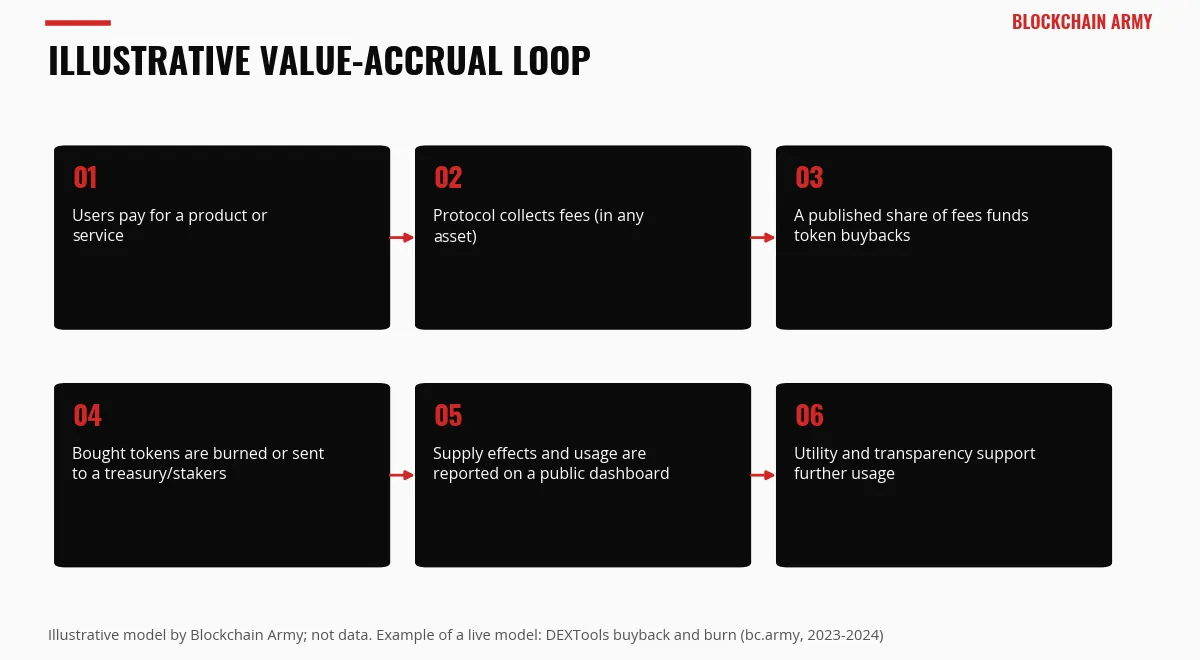
DEXTools is a public example of the buyback-and-burn approach: part of its revenue has been used to buy back and burn its DEXT token, which we analysed in DEXT buyback and burn model 2.0 and in our quantitative analysis of the DEXTools deflationary model. We also built the public DEXTools burn dashboard, which tracks daily burns, circulating supply and the projected yearly burn rate.
Lessons that apply to any project:
- The revenue must be real. Burns funded from treasury token reserves or new emissions are just accounting.
- Make it verifiable. Publish wallet addresses, the share of revenue used, and the schedule. A dashboard beats a quarterly tweet.
- Mind the legal angle. Direct revenue sharing can strengthen arguments that a token is an investment product. Take advice before promising cash flows to holders.
8. Liquidity and market making
A token with good design and thin liquidity will still trade badly. Plan:
- Initial liquidity: how much of each side (token and stablecoin/ETH) goes into DEX pools, on which venues, and whether LP tokens are locked.
- Centralized exchange depth: listing requirements often include market-maker commitments on spread and depth.
- Market-maker terms: understand loan size, option strikes, term, reporting and KPIs. Ask for regular reports you can verify.
- Monitoring: track pool depth, holder concentration and large transfers from day one.
9. Governance
Governance tokens rarely govern much at launch. Be explicit about what token holders control today, what the team controls, and how control will move over time. Use timelocks on parameter changes, multisigs with independent signers for treasuries, and clear quorum rules. Low turnout combined with concentrated holdings makes governance capture cheap.
10. Regulatory considerations (not legal advice)
European Union (MiCA). Under Article 4 of the Markets in Crypto-Assets Regulation, a person offering crypto-assets other than asset-referenced or e-money tokens to the public in the EU must be a legal person and must draw up, notify and publish a crypto-asset white paper, with marketing communications that comply with the regulation. There are exemptions, including offers to fewer than 150 persons per member state, offers with total consideration up to EUR 1 million over 12 months, and offers solely to qualified investors. Under Article 8, the white paper is notified to the home member state's competent authority at least 20 working days before publication; authorities do not pre-approve it. ESMA's register notes that listed white papers have not been reviewed or approved by any competent authority. The MiCA transitional period for existing service providers ended on 1 July 2026; see our coverage of what that means for crypto marketing.
United States. On 17 March 2026, the SEC issued an interpretive release, with CFTC guidance, on how federal securities laws apply to certain crypto assets. According to law firm summaries, it sets out a taxonomy in which only "digital securities" are inherently securities, explains when an investment contract can end, and notes that marketing statements about the issuer's efforts and expected profits weigh toward investment-contract treatment. It supersedes the SEC staff's 2019 framework. The legislative picture is still moving; see our note on the CLARITY Act Senate vote. How you describe the token, especially any promise of returns, matters. Get qualified legal advice in each jurisdiction where you offer the token.
11. Modelling and stress tests
Build a spreadsheet or simulation before you finalise anything. At minimum:
| Test | What to model |
|---|---|
| Supply over time | Circulating supply month by month from all sources: vesting, emissions, airdrops, burns |
| Unlock absorption | Market cap needed at each major unlock to keep price flat |
| Incentive cost | Tokens emitted per unit of target behaviour, and its dollar cost at several prices |
| Revenue scenarios | Buyback or fee-share sizes at low, base and high usage |
| Price shock | Effect of a 50-80% drawdown on treasury runway, staking yields and liquidity |
| Concentration | Share held by top wallets and insiders after each unlock |
Revisit the model after launch with real data and publish material changes in advance.
12. Common failure modes
- Low float and high FDV with large cliffs landing close together.
- Incentive programs without an end date or a measurable goal.
- Burns or "real yield" funded by emissions rather than revenue.
- Team-controlled "community" allocations without disclosure.
- Marketing concentrated on TGE week, with nothing planned for the unlock months.
- Unclear mint, pause or upgrade authority in the token contract.
- Revenue-sharing promises made without legal review.
Tokenomics checklist
| Area | Question to answer before launch | Done |
|---|---|---|
| Purpose | Can you state the token's job in one sentence? | |
| Supply | Is max supply, issuance and mint authority published? | |
| Allocation | Do you know insider share and each cohort's cost basis? | |
| Vesting | Are cliffs staggered and schedules machine-readable? | |
| Float | Have you modelled market cap at each major unlock? | |
| Incentives | Does every program have a goal, decay and end date? | |
| Value accrual | Is the mechanism funded by real revenue and verifiable on chain? | |
| Liquidity | Are pool sizes, venues and market-maker terms agreed? | |
| Governance | Are timelocks, multisigs and holder powers documented? | |
| Regulation | Have you taken advice on MiCA, US and other relevant rules? | |
| Communication | Is there a plan for every major unlock, not only TGE? |
If you want help building or reviewing a model, our tokenomics development service covers allocation, vesting, emissions, value accrual and the supporting documents.
FAQ
What is the difference between market cap and FDV?
Market cap uses circulating supply; FDV uses maximum supply. The difference is supply that will enter the market later through unlocks or emissions, and it has to be absorbed by new demand.
How long should team vesting be?
There is no fixed rule, but team vesting should generally be at least as long as investor vesting, with linear unlocks after any cliff. Long, gradual schedules signal commitment and reduce single-day supply shocks.
Does buyback-and-burn make a token go up?
Not on its own. A burn reduces supply only if it is funded by real revenue, and its effect depends on the size of buybacks relative to trading volume and new supply. It is a value-accrual mechanism, not a price guarantee.
Are airdrops worth it?
They can be, if eligibility rewards real usage and the token has adequate liquidity and a realistic valuation. Keyrock's 2024 study found most airdropped tokens fell within months, so treat an airdrop as user acquisition with a cost, not free marketing.
Do I need a MiCA white paper?
If you offer a crypto-asset (other than an asset-referenced or e-money token) to the public in the EU and no exemption applies, MiCA requires you to draw up, notify and publish a white paper. Take legal advice to confirm whether an exemption applies to your offer.
When should tokenomics be finalised?
Before you raise money on token terms. Allocation, vesting and investor rights are hard to change once agreements are signed, so model the full lifecycle first.
Sources
- CryptoPotato — The harsh reality of new crypto: just 7% of major tokens beat their launch price (CryptoRank data, 21 July 2026)
- Keyrock — From locked to liquidity: what 16,000+ token unlocks teach us
- Keyrock — Airdrops in the barren desert: surveying the traits behind 2024's 11% success rate
- ESMA Interactive Single Rulebook — MiCA Article 4: Offers to the public of crypto-assets other than ARTs or EMTs
- MiCA Regulation (EU) 2023/1114 — Article 8: Notification of the crypto-asset white paper
- ESMA — Markets in Crypto-Assets Regulation (MiCA)
- SEC — Application of the Federal Securities Laws to Certain Types of Crypto Assets (Release No. 33-11412, 17 March 2026)
- Orrick — SEC issues interpretive guidance on crypto asset classification (April 2026)
How we research, write and fact-check: Editorial & AI policy.
Disclaimer: this article is for informational and educational purposes only and does not constitute financial, investment, legal or tax advice. Crypto-assets are volatile and high-risk: always do your own research (DYOR) and consult a qualified professional before making any decision. Not financial advice.