
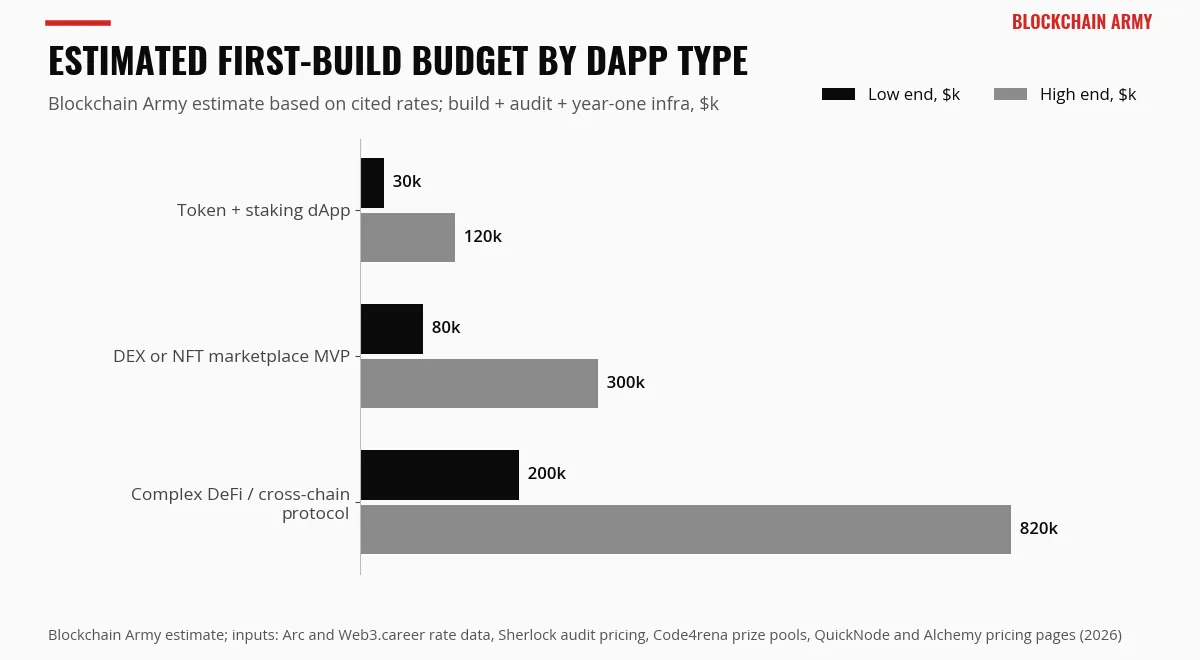
A realistic 2026 budget for a decentralized application runs from roughly $30,000–$120,000 for a simple token and staking dApp, $80,000–$300,000 for a DEX or NFT marketplace MVP, and $200,000–$800,000 or more for a complex DeFi protocol or cross-chain app. These are our estimates, built bottom-up from published developer rates, audit prices and infrastructure pricing, and every assumption is listed below so you can swap in your own numbers.
One surprise for teams who last budgeted in 2021: on-chain deployment is now one of the smallest line items. People, audits and post-launch operations are where the money goes.
How we built these numbers
Most "dApp cost" figures online are a single range with no working shown. We did it the other way round: scope tier × component × person-weeks × a day rate, then added audit and infrastructure costs from public price lists.
Rate assumption: $75–$150 per hour, or $3,000–$6,000 per person-week (40 hours). This is our estimate, based on:
- Arc's published rates for freelance blockchain developers: a median of $61–80 per hour and an average of $81–100 per hour.
- Web3.career's Solidity developer data: an average of $78 per hour, with a range of $33–134 per hour.
- The U.S. Bureau of Labor Statistics median wage for software developers: $135,980 a year (May 2025), which is an employee wage before benefits, overheads and margin.
The low end of our range assumes a mid-level freelance or nearshore team. The high end assumes senior specialists or an agency rate that includes project management and overheads. Teams in lower-cost regions can come in below our low end; top-tier U.S. firms can go well above our high end.
What drives the cost
Five variables explain most of the spread:
- Smart contract complexity. A token with staking built on audited libraries is a few hundred lines. A lending market or perpetual DEX with oracles, liquidations and upgradeability is tens of thousands. Code4rena's K2 contest in April 2026, for example, covered 15,487 nSLoC (normalized source lines of code) in scope.
- Value at risk. The more user funds a contract will hold, the more testing, review and audit time it justifies.
- Chain and tooling. EVM chains share Solidity, Foundry/Hardhat and OpenZeppelin. Solana uses Rust and a different account model, so the talent pool and audit market differ.
- Off-chain components. Indexers, APIs, price feeds, notification services and admin dashboards are often half the engineering work, and they are what users actually touch.
- Number of chains. Each extra chain adds deployment, testing, monitoring and, for bridges or messaging, a whole new attack surface.
Cost by component
The table shows effort ranges for a mid-sized build (our DEX or NFT marketplace MVP tier). Dollar figures apply our $3,000–$6,000 per person-week rate.
| Component | What it covers | Person-weeks (our estimate) | Cost range (our estimate) |
|---|---|---|---|
| Smart contracts | Design, implementation, unit and fuzz tests | 6–10 | $18,000–$60,000 |
| Front-end and wallet integration | Web app, wallet connection, transaction flows, error states | 6–10 | $18,000–$60,000 |
| Back-end and indexing | Event indexer, API, database, caching | 4–8 | $12,000–$48,000 |
| UI/UX design | Flows, components, responsive layouts | 2–4 | $6,000–$24,000 |
| PM and QA | Planning, testnet QA, release management | 3–6 | $9,000–$36,000 |
| Security audit | External review of contracts | n/a | $15,000–$60,000 (see audit section) |
| Infrastructure, year one | RPC, hosting, monitoring | n/a | $3,000–$15,000 (our estimate) |
| Deployment gas | Contracts on mainnet | n/a | Usually under $200 on Ethereum in September 2026; see chain section |
Cost by project type
| Project type | Typical scope | Build effort (our estimate) | Build cost | Audit | Total first build (our estimate) |
|---|---|---|---|---|---|
| Token + staking dApp | ERC-20 or SPL token, staking/rewards contract, simple web app | 7–16 person-weeks | $21,000–$96,000 | $8,000–$20,000 | $30,000–$120,000 |
| DEX or NFT marketplace MVP | AMM or order-based swaps, or listing/bidding/royalties, indexer, full front-end | 21–38 person-weeks | $63,000–$228,000 | $15,000–$60,000 | $80,000–$300,000 |
| Complex DeFi or cross-chain protocol | Lending, derivatives, vaults, oracles, governance, multi-chain messaging | 45–80 person-weeks | $135,000–$480,000 | $60,000–$300,000+ | $200,000–$800,000+ |
Totals include year-one infrastructure (our estimate: $1,000–$5,000, $3,000–$15,000 and $10,000–$40,000 respectively) and are rounded. They exclude legal work, liquidity, marketing and token-launch costs, which we cover under hidden costs.
Timeline matters as much as the total. Our own VVITA case study, an NFT and metaverse marketplace project, lists a development time of five months, and the engagement also covered tokenomics, a whitepaper, the public website and community management. Real projects bundle more than code.
How chain choice changes the bill
In 2021, deployment gas was a serious budget line on Ethereum. In 2026 it mostly is not. The heaviest single contract allowed under EIP-170 is 24,576 bytes; EIP-8037 puts the current gas for deploying a 24 kB contract at about 4.9 million gas. We rounded that to 5 million gas and priced it with real daily averages:
| Network and period | Average gas price | Cost to deploy one max-size (24 kB) contract (our calculation) |
|---|---|---|
| Ethereum, 2021 average | 105 gwei | about $1,320 |
| Ethereum, highest daily average of 2026 to date (22 April 2026) | 4.97 gwei | about $62 |
| Ethereum, 1–21 September 2026 average | 0.83 gwei | about $10 |
| Base, 1–21 September 2026 average | 0.042 gwei | about $0.50 (plus an L1 data fee) |
| Arbitrum One, 1–21 September 2026 average | 0.021 gwei | about $0.26 (plus an L1 data fee) |
Gas prices are Etherscan, Basescan and Arbiscan daily averages. To isolate the effect of gas, all rows use the same ETH price: the 1–21 September 2026 average of about $2,505 (Etherscan). On L2s, the chart figures cover execution gas only; rollups also charge a separate fee for posting data to Ethereum, which these charts do not include.
So even a ten-contract protocol deployed to Ethereum mainnet at September 2026 prices would spend on the order of $100 in gas. Two caveats:
- Gas can spike. Daily averages hide intraday peaks. Budget a buffer and deploy in quiet hours.
- Rules may change. EIP-8037, a proposal to raise the gas cost of creating state, would take the same 24 kB deployment from about 4.9 million to about 37.8 million gas. If a version of it ships in a future upgrade, Ethereum deployment costs rise several-fold. Our Glamsterdam explainer tracks what is changing.
Solana works differently. Deploying a program means funding a rent-exempt account sized to the program binary. Under SIMD-0437, the rent rate fell from 6,960 to 5,080 lamports per byte, with the second step active on mainnet since 11 September 2026. A 200 KB program therefore needs about 1.02 SOL, roughly $113 at CoinGecko's SOL price of about $111 on 21 September 2026 (our calculation). That deposit is recoverable if the program is closed, and further reduction steps are planned.
The bigger chain decision is people, not gas. EVM teams can reuse OpenZeppelin, mature testing tools and a large audit market. Solana and other non-EVM stacks can be the right call for throughput-heavy products, but expect a smaller hiring pool and fewer off-the-shelf components.
Audit costs
The audit is the line item teams most often underbudget. Sherlock, an audit provider, states that smart contract audits in 2026 range from $8,000 to over $300,000, that most protocols pay $15,000–$40,000 for a typical pre-launch review, that a simple staking contract can come in under $20,000, and that a mid-sized DeFi protocol starts around $60,000 and can exceed $100,000.
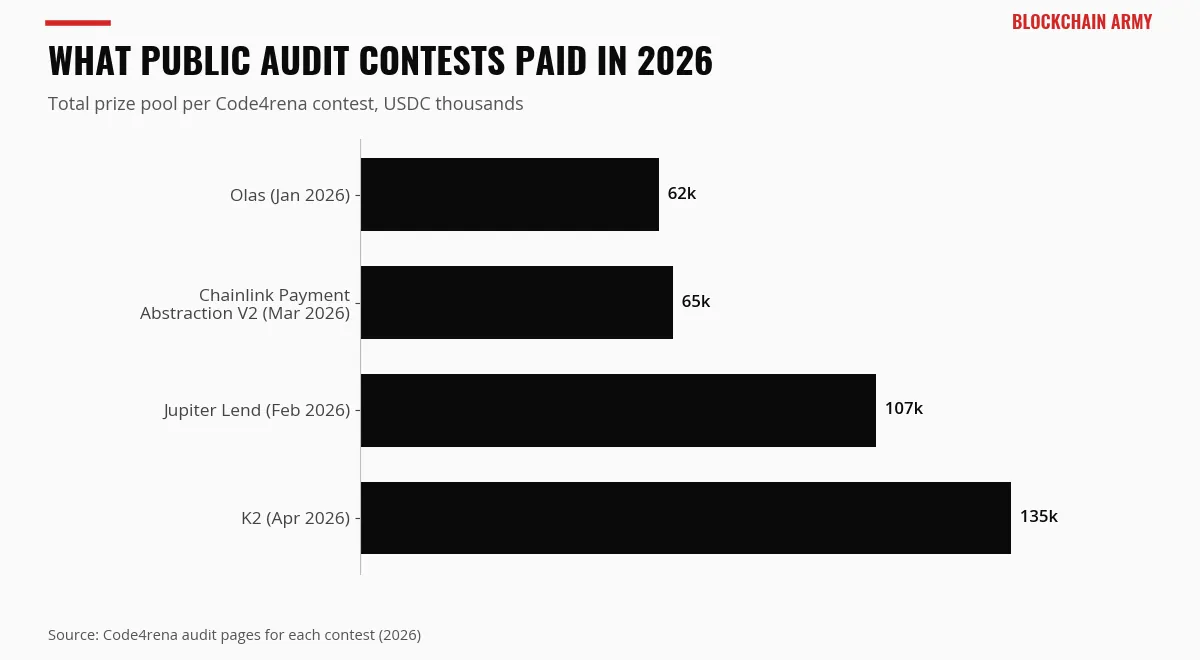
Competitive audit contests show what larger protocols pay for public review. Code4rena prize pools in early 2026 ranged from $62,000 to $135,000:
The market is shifting. Code4rena announced on 13 May 2026 that it was winding down, with Immunefi taking over its bug bounty customers and researchers, according to The Block. Contest-style review still exists on other platforms, but compare current providers before you plan around one.
Practical audit budgeting:
- Freeze the code first. Sherlock notes that code changes during an audit can push a mid-sized DeFi audit past $100,000.
- Plan a fix review. The re-check of your fixes is often a separate line.
- Match depth to value at risk. A staking contract for a small community and a lending market holding eight figures do not need the same audit.
Our smart contract audit checklist covers preparation, and our audit review service helps teams read and act on findings.
Ongoing costs after launch
A dApp is never finished. Budget these from day one:
| Item | Published price points | Annual budget (our estimate) |
|---|---|---|
| RPC and node access | QuickNode: Build $49/month (80M API credits), Accelerate $249/month, Scale $499/month, Business $999/month. Alchemy: free tier with 30M compute units a month, then $0.52 per 1M compute units pay-as-you-go | $600–$12,000 |
| Hosting, indexer database, monitoring | Varies by provider | $1,000–$20,000 |
| Maintenance and upgrades | Developer time for fixes, dependency updates, new chain versions | 15–25% of build cost per year |
| Bug bounty reserve | Immunefi's own program pays 10% of funds directly affected for critical bugs, with a $10,000 minimum and $50,000 cap; Haven1's critical range is $15,000–$100,000 | Budget at least one critical payout in reserve |
| Re-audits | Any meaningful contract change | Price as a new, smaller audit |
The maintenance percentage is a planning rule of thumb, not a published statistic. Treat it as our estimate.
Ways to cut cost safely
Cutting cost is fine. Cutting security is not. These levers lower the bill without raising risk:
- Ship an MVP scope. Launch the one flow that proves demand, then expand. Our MVP development service and the MVP development explainer cover how to scope one.
- Use audited libraries. OpenZeppelin Contracts covers tokens, access control, upgradeability and more. Less custom code means fewer audit hours.
- Live on testnets longer. Testnet deployments cost nothing in real money and catch integration bugs before an auditor bills for them.
- Phase your audits. Audit the core contracts before launch, then audit new modules as they ship, rather than paying for everything at once.
- Start on one chain. Go multi-chain once usage justifies it.
- Prefer managed infrastructure early. Hosted RPC plans start at tens of dollars a month; running your own nodes rarely pays off before real scale.
If you are starting from zero, our guide to building your first blockchain application walks through the stages.
Hidden costs most budgets miss
- Legal and regulatory work. If you offer a token to the public in the EU, MiCA requires a crypto-asset white paper notified to your home regulator at least 20 working days before publication, according to ESMA's MiCA rulebook. Regulators do not pre-approve it, and the issuer is responsible for its content. Our MiCA transition explainer covers what changed in 2026. Budget for specialist counsel in every jurisdiction you target.
- Liquidity and market making. A DEX pool or token listing needs capital, and that capital is at market risk. It is not a development cost, but it is a launch cost.
- Marketing and community. A shipped dApp with no users is a sunk cost. Community setup, content and launch campaigns often rival the engineering budget.
- Tokenomics and documentation. Token design, whitepaper and docs take specialist time.
- Your own team's time. Founders spend weeks on specs, reviews and testing. It does not appear on an invoice, but it is real.
What this means for teams planning a build
Start with three numbers: the scope tier, the value at risk and the launch date. Those set your engineering effort, your audit depth and how much runway you need after launch. Then hold back 15–25% of the total as contingency, because almost every project discovers scope it did not plan for.
If you want these ranges turned into a line-by-line plan for your product, ask us for a scoped quote through our Web3 app development service.
FAQ
What is the cheapest realistic budget for a dApp?
A simple token and staking dApp built on audited libraries, with a basic front-end and a small audit, starts at around $30,000 in our estimate. Below that, teams usually skip the audit or testing, which is a false economy once real funds are involved.
How much does it cost to deploy a smart contract on Ethereum in 2026?
At September 2026 gas levels, about $10 for a maximum-size 24 kB contract, based on Etherscan's 0.83 gwei average for 1–21 September and an ETH price around $2,505. Gas spikes and future protocol changes such as the proposed EIP-8037 could raise that.
How much should I budget for a smart contract audit?
Sherlock puts 2026 audits between $8,000 and over $300,000, with most pre-launch reviews at $15,000–$40,000. Simple contracts sit at the low end; complex DeFi and multi-chain systems at the top.
Is it cheaper to build on Solana than on Ethereum?
Deployment and transaction costs are low on both Solana and Ethereum L2s. The bigger difference is engineering: EVM chains have more reusable libraries and auditors, while Solana requires Rust expertise. Total cost depends more on your team than on the chain.
What are the ongoing costs of running a dApp?
Expect RPC plans from free tiers up to about $1,000 a month, hosting and monitoring, maintenance of roughly 15–25% of the build cost per year (our estimate), re-audits for contract changes, and a bug bounty reserve.
How long does it take to build a dApp?
Dividing our effort ranges across a team of three to five people gives roughly one to two months of build time for a simple dApp, two to three months for a DEX or marketplace MVP, and three to five months for a complex protocol. Calendar time usually runs longer once audits, fixes and dependencies are added.
Sources
- Arc — Freelance blockchain developer rates
- Web3.career — Solidity developer salary
- U.S. Bureau of Labor Statistics — Occupational Outlook Handbook: Software Developers
- Sherlock — Smart contract audit cost
- Code4rena — Olas audit (January 2026)
- Code4rena — Jupiter Lend audit (February 2026)
- Code4rena — Chainlink Payment Abstraction V2 audit (March 2026)
- Code4rena — K2 audit (April 2026)
- The Block — Immunefi to absorb Code4rena bug bounty customers after shutdown decision (13 May 2026)
- Immunefi — Immunefi bug bounty program information
- Immunefi — Haven1 bug bounty program
- QuickNode — Pricing
- Alchemy — Pricing
- Etherscan — Ethereum average gas price chart (daily data)
- Etherscan — Ether daily price (USD) chart
- Basescan — Base average gas price chart (daily data)
- Arbiscan — Arbitrum One average gas price chart (daily data)
- Ethereum Improvement Proposals — EIP-170: Contract code size limit
- Ethereum Improvement Proposals — EIP-8037: State Creation Gas Cost Increase
- Chainstack — Solana rent reduction (SIMD-0437) and reclaiming excess rent
- Solana Compass — Solana's first rent reduction goes live on testnet under SIMD-0437 (28 August 2026)
- CoinGecko — Solana (SOL) historical data
- ESMA — MiCA Interactive Single Rulebook, Article 8: Notification of the crypto-asset white paper
- ESMA — Markets in Crypto-Assets Regulation (MiCA)
How we research, write and fact-check: Editorial & AI policy.
Disclaimer: this article is for informational and educational purposes only and does not constitute financial, investment, legal or tax advice. Crypto-assets are volatile and high-risk: always do your own research (DYOR) and consult a qualified professional before making any decision. Not financial advice.